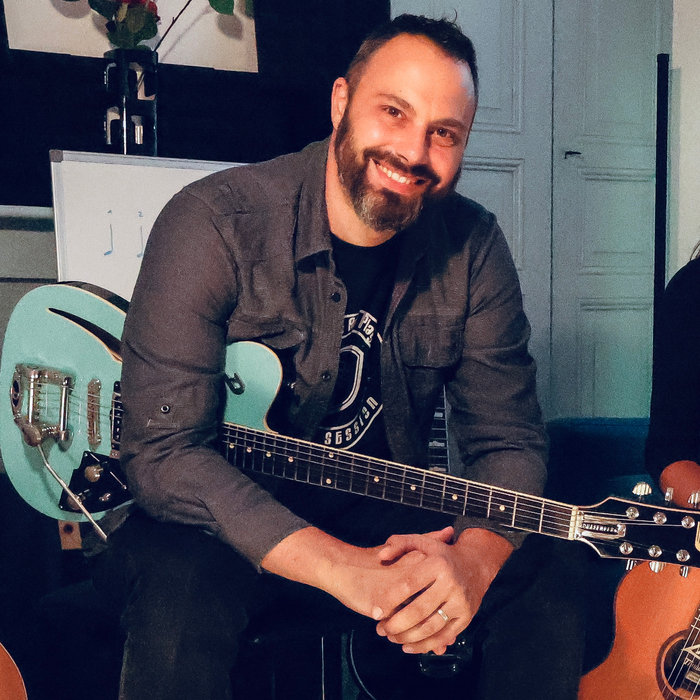
 Guitar Master · published by Solfia Édition, designed with Jean-Christophe Vignon, guitar teacher
Every tool
a guitarist needs.
One app.
Write out your song's chord chart and the app shows you what to play over it: the scale, the arpeggio, the bass line, the piano accompaniment. Twenty-four tools, four trainers and a 198-step programme, developed by Solfia Édition with a guitar teacher — for his own students first.
A core set of tools stays free for everyone, with no subscription.
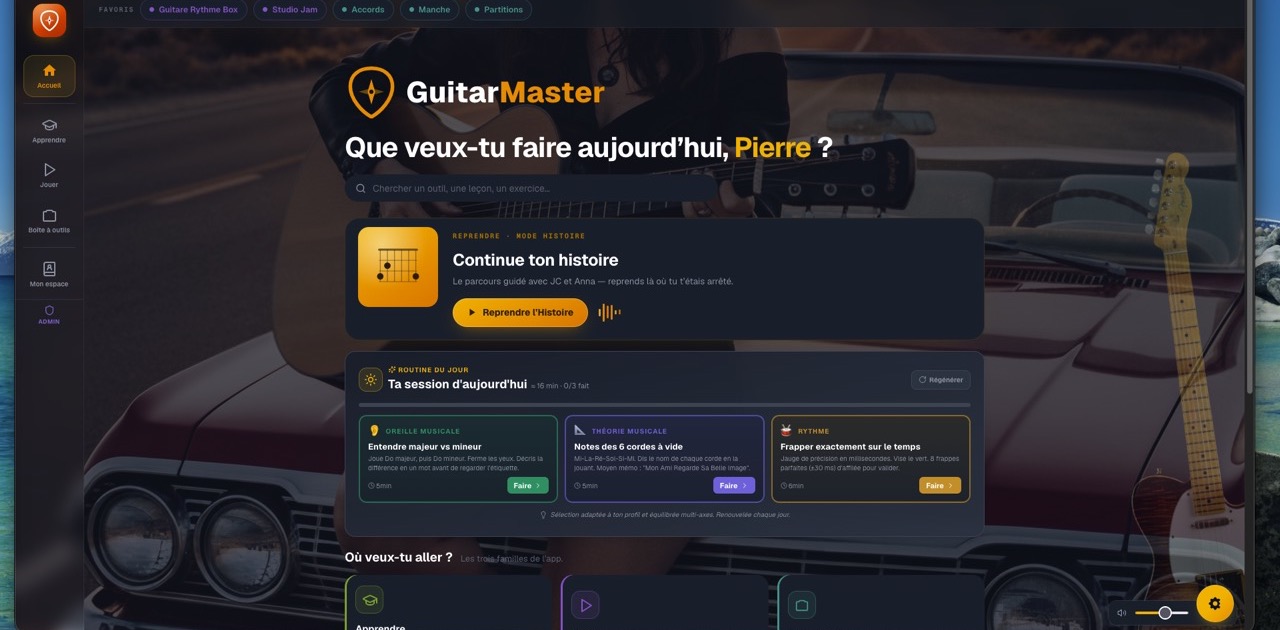
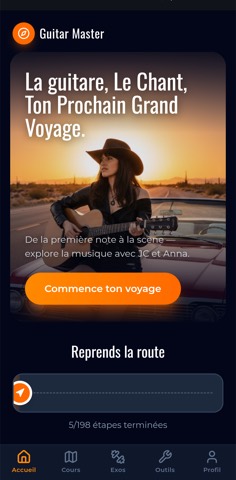
You are…
The same app, three uses with nothing in common. Pick yours and the page takes you straight to the right section.
A guitarist working alone
You don't take lessons, or not any more. You want something to work with seriously: a band behind you, the fretboard finally clear, rhythm made visible, a programme that holds together.
What's in the app →My student, or soon to be
You take lessons with me over video. The app is included: your exercises land in it at the end of every session, and the lesson itself takes place inside it.
What's included →A guitar teacher
You teach, and you're looking for what I was looking for: a real tool to leave with your students between lessons. Your own space, your own locker, up to 35 students.
The teacher plan →You work on your own
The problem was never a shortage of videos. It's knowing what to work on, how to work on it, and hearing yourself play it right. Here is what the app puts at your disposal — in pictures, with real screenshots. Tap a screenshot to enlarge it.
Write your chord chart.
The app shows you what to play over it.
Four generators, one principle: you lay out your song's chords, and the app builds what there is to play over them — the scale, the arpeggio, the bass line, the piano accompaniment. It plays it, shows it on the fretboard and writes it out in tab. Your teacher can send you one after a lesson.
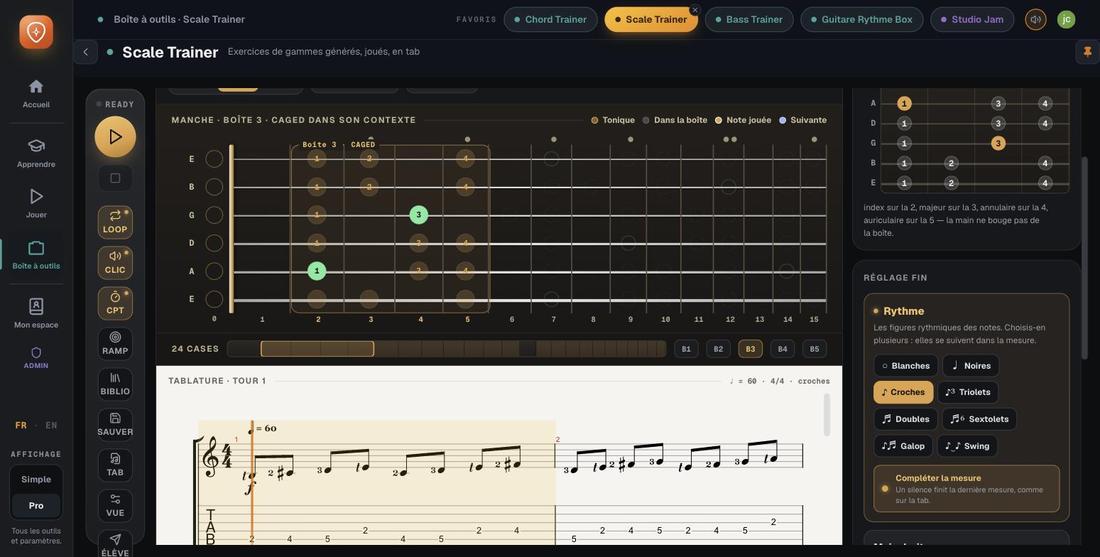
Scale Trainer
Scales & arpeggiosWrite your chord chart, and the app shows you what to play over it: the scale that fits each chord, the arpeggio of the chord itself, or the scale of the song from start to finish. The exercise is built for you, never the same twice — it plays at the tempo you push up little by little, appears on the fretboard and is written out in tab. Four ready-made levels to get going without setting anything up.
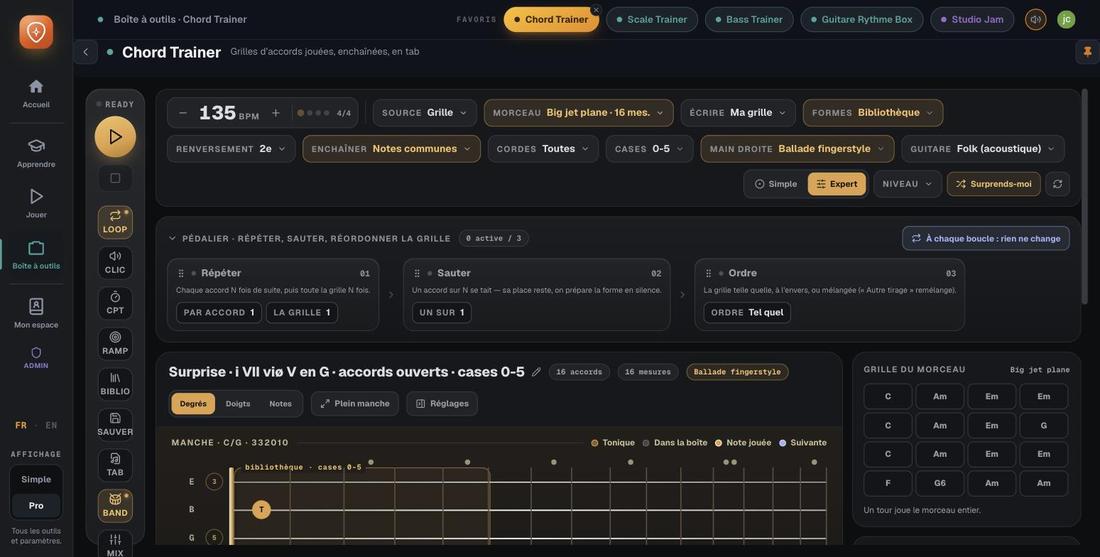
Chord Trainer
ChordsThe real question, when you change chord, is choosing the position that follows on well from the last one. The app takes care of that and shows you the way, chord after chord. Strummed, arpeggiated, fingerpicked, or over a rhythm you write yourself. Five ready-made starting points: open chords, barre chords, triads, ii-V-I cadence, jazz.
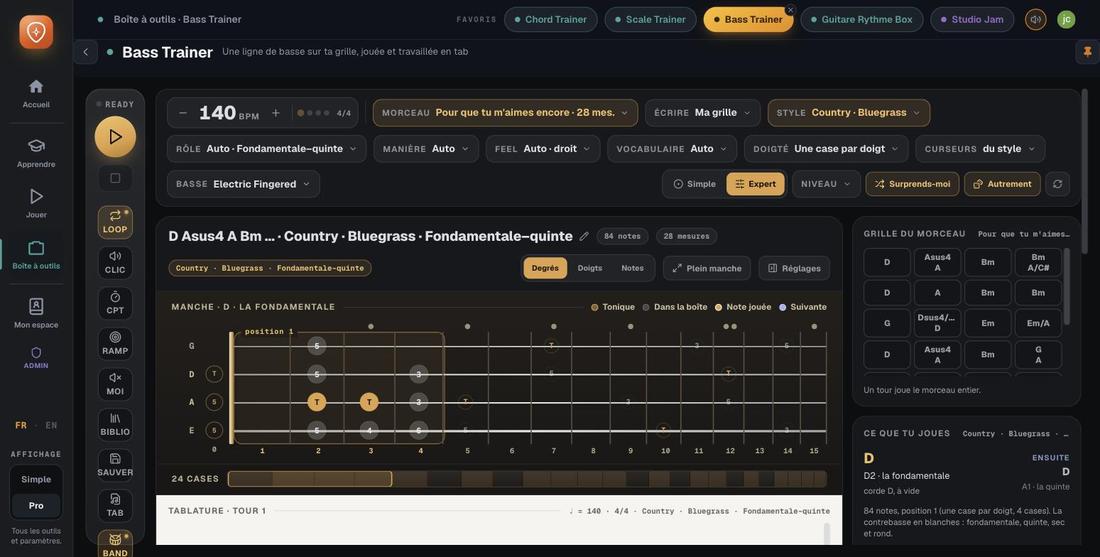
Bass Trainer
BassPop, rock, blues, jazz, funk, soul, reggae, gospel, bossa, country, disco, neo-soul, metal, ballad… and thirty-seven sub-styles behind them. You write the chord chart, the app writes a real bass line over it — with the ghost notes and the placement that make the style. Listen to it and play over the top, or work it up yourself from the tab.
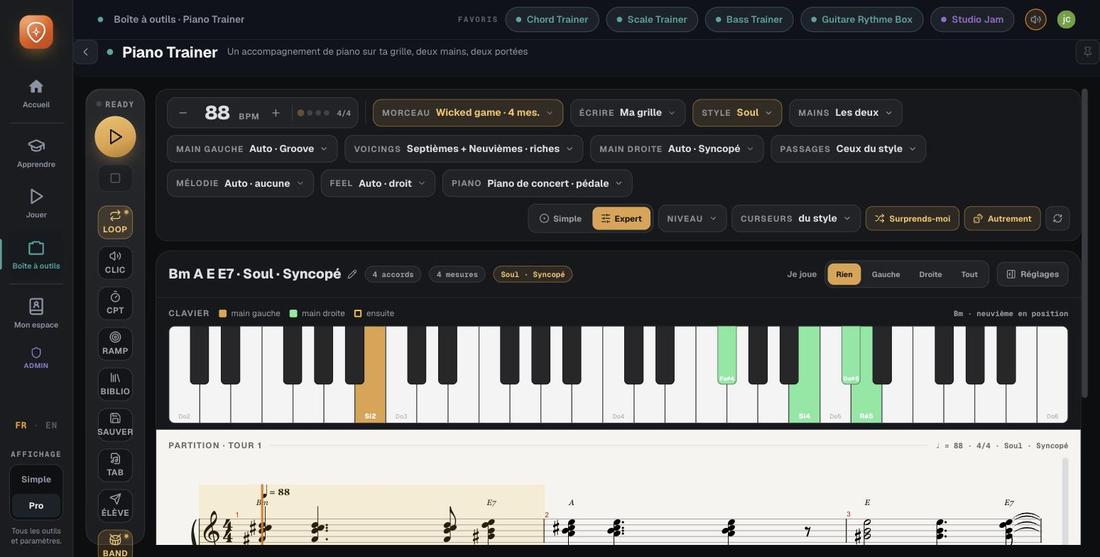
Piano Trainer
PianoPop, ballad, rock, country, classical, jazz, bossa nova, soul, R&B, gospel, blues, funk, reggae, disco, latin… The left hand and the right hand are written separately, with the melody, the counter-melody and the pedal, and appear on two staves like a real score. It also serves as accompaniment in Studio Jam — and lets you hear the harmony away from the guitar.
Plug your guitar in.
Eleven amps are waiting.
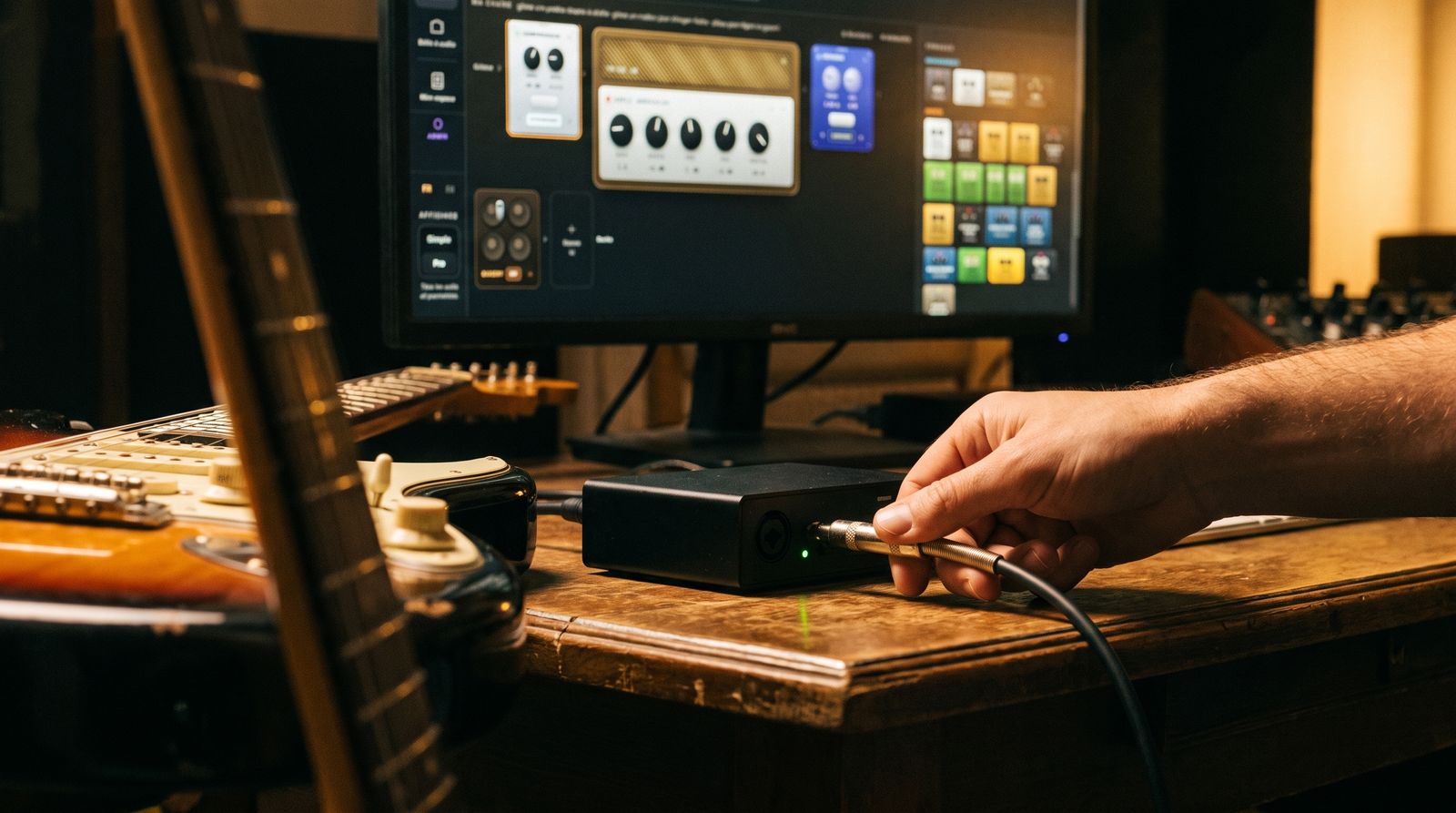
Not a rough simulation: real captured amps, modelled by a neural network, running in your browser. You plug your jack in, you pick an amp, you play. Nothing to install, nothing to buy.
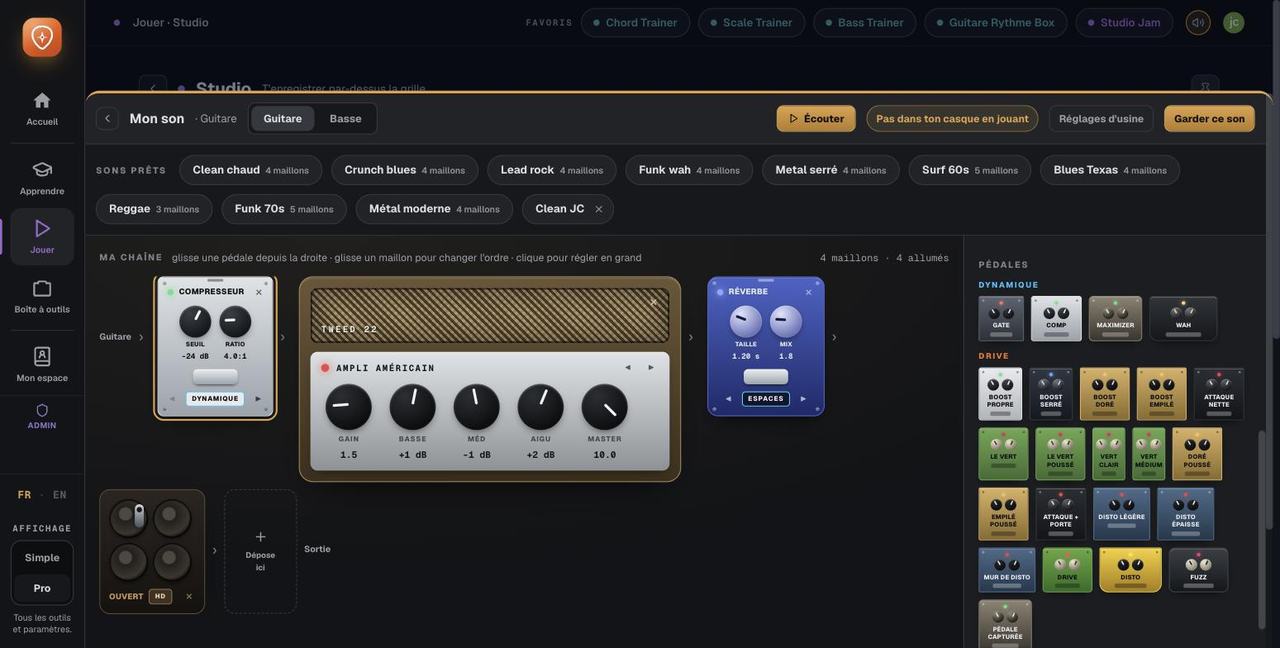
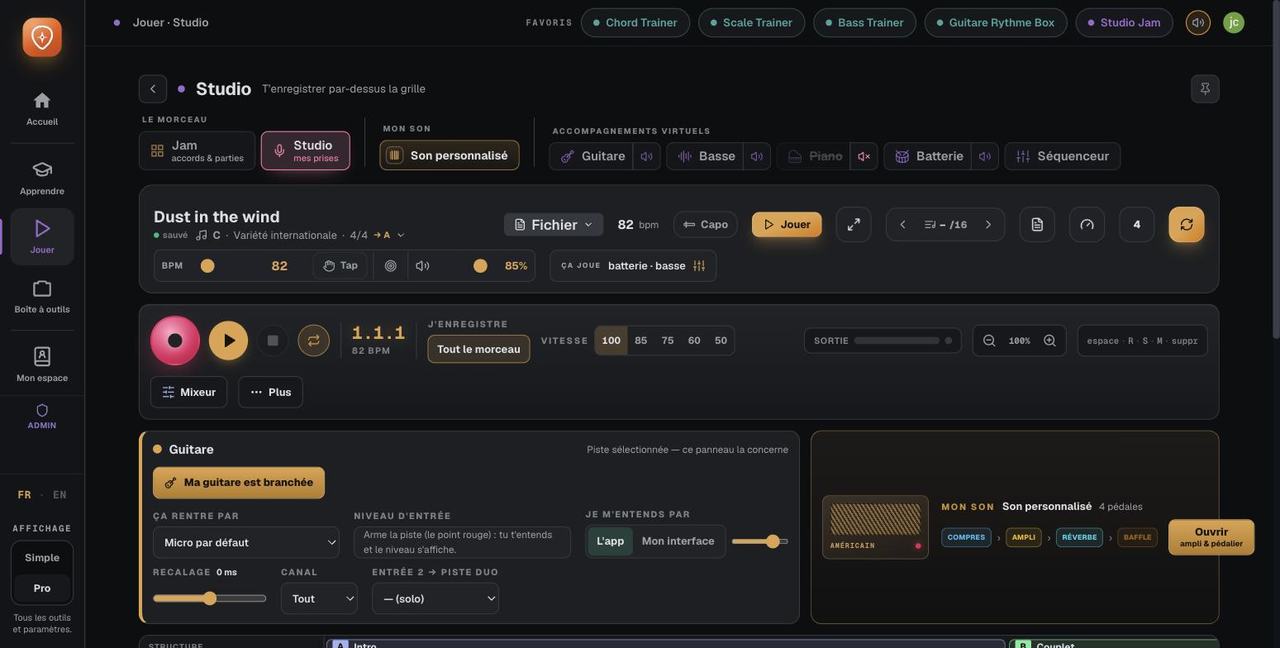
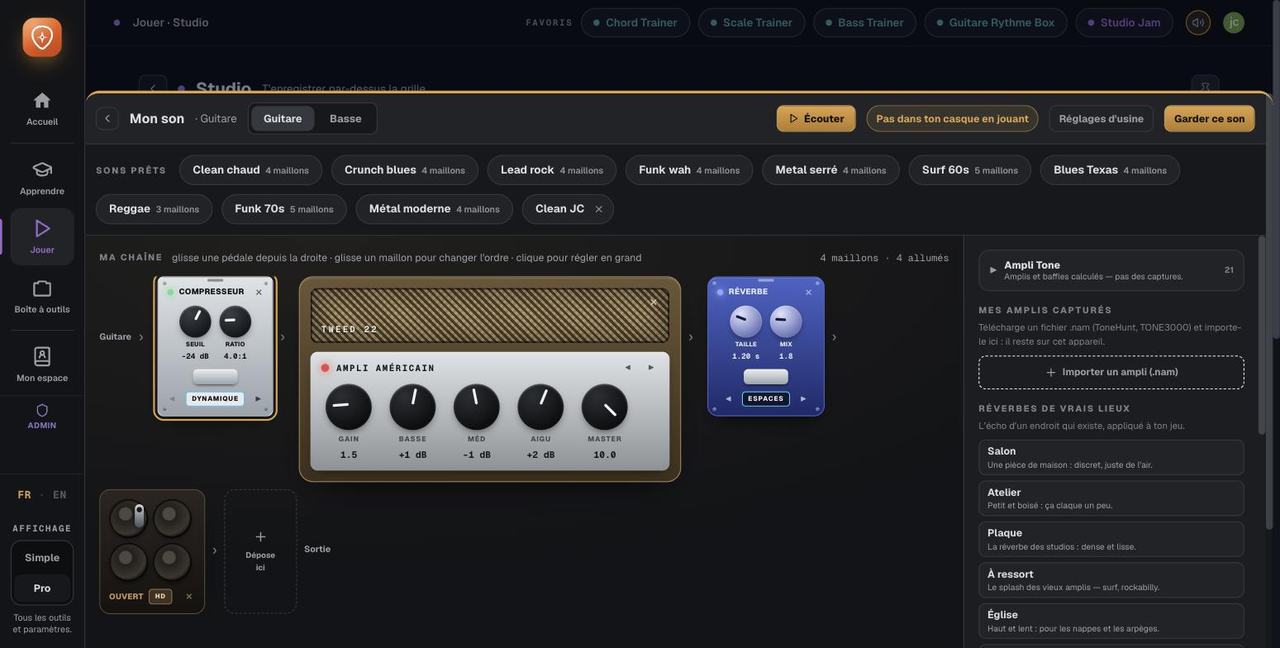
Eleven captured amps
SoundEach amp is the sonic photograph of a real machine : sound was sent through it, and a small neural network learned to answer in exactly the same way. Ten guitar amps, one bass amp, six cabs and six reverbs recorded in real spaces. You can even import your own captures : they stay on your device.
Twenty-seven pedals
PedalboardCompressor, auto-wah, overdrive, distortion, fuzz, chorus, phaser, tremolo, flanger, delay, spring reverb… fifteen of the pedals are captures too of real boxes. The chain runs in the order of a real pedalboard, and fifteen ready-made settings save you building it all yourself.
You record yourself
MultitrackThe studio records while the accompaniment plays your chord chart. Five tracks, your sound card's latency corrected automatically, the best takes comped together, and the finished song exported as WAV or MP3. Enough to hold on to an idea before it gets away.
The song writes itself
AnalysisDrop in a recording: the app works out its tempo, key, chords and section structure, then writes out the chord chart. It even searches thirteen thousand drum grooves for the one that sounds closest to what it has just heard. You correct whatever you like, and you play over it.
“A student who can't hear themselves properly doesn't play the same way. I wanted people to be able to plug in their guitar and get a real sound straight away, without buying software or working out how it runs.” — JC
The studio needs a computer and, to plug in an electric guitar, a small audio interface. At home, it replaces software costing several hundred euros.
The one nobody ever works on.
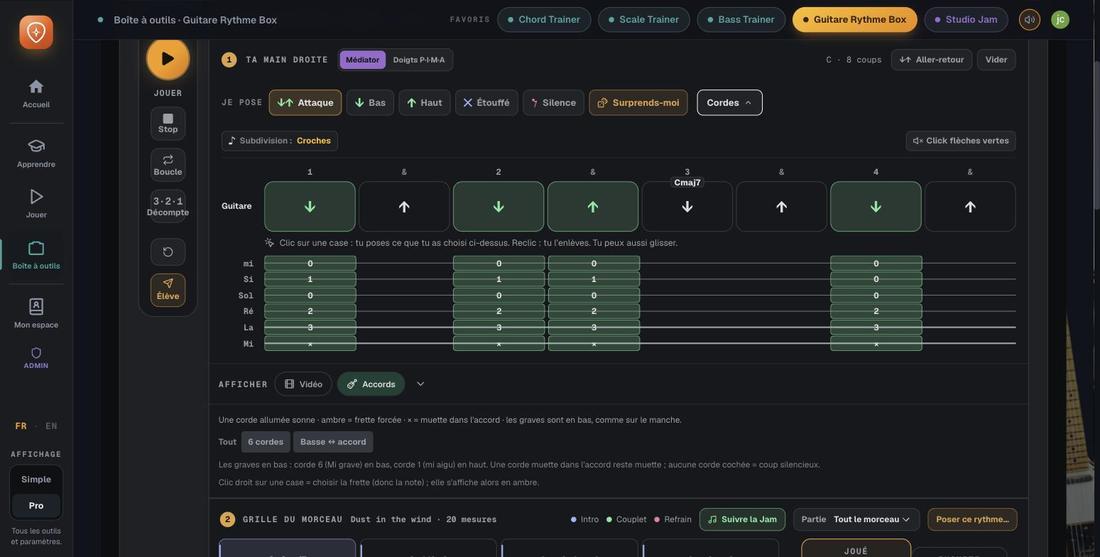
You spend years on the fretting hand, and the picking hand is left to chance. The Guitare Rythme Box gives it a workshop of its own: you write your strumming pattern stroke by stroke, with a pick or with your fingers, you hear it over the chords of your song, and you loop it until it holds together.
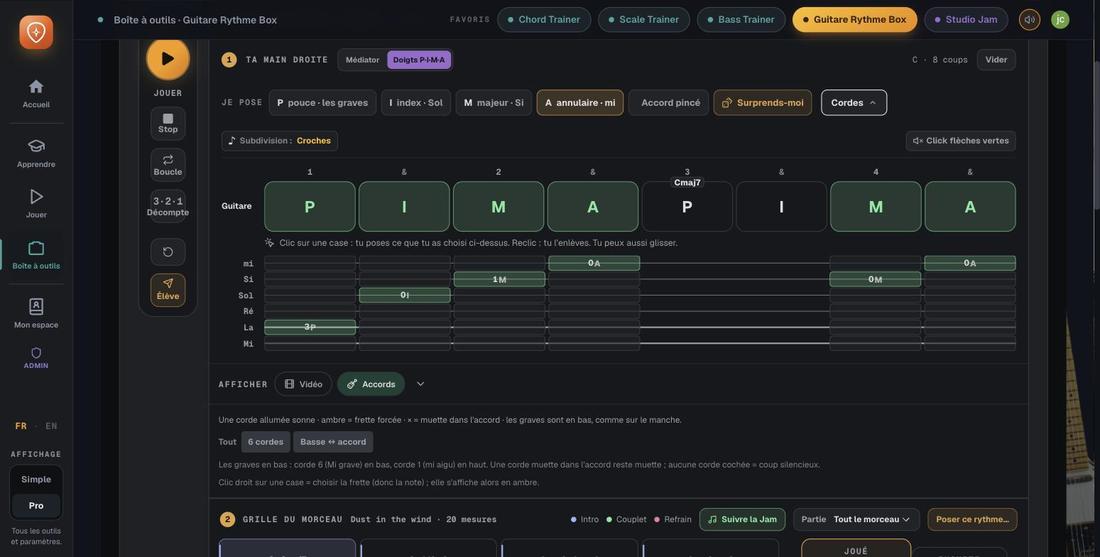
“In sixteen years of teaching, this is what comes up most often: ‘I know my chords, but it doesn't sound right.’ Nine times out of ten, it's the picking hand.” — JC
Nineteen drum grooves and twenty-three picking-hand patterns come with it to get you started. Yours can be saved and renamed, and your teacher can send you one after the lesson.
Twenty-four tools,
all in one place.
Normally it's a tuner here, a metronome there, a chord website, a video tab and a tab-editing program. Here it's all in the same window, on the same song. Nine of them in pictures below — real screenshots of the app, not illustrations. The full list follows.
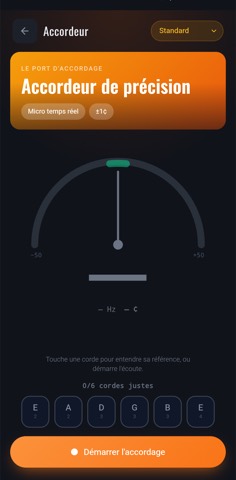
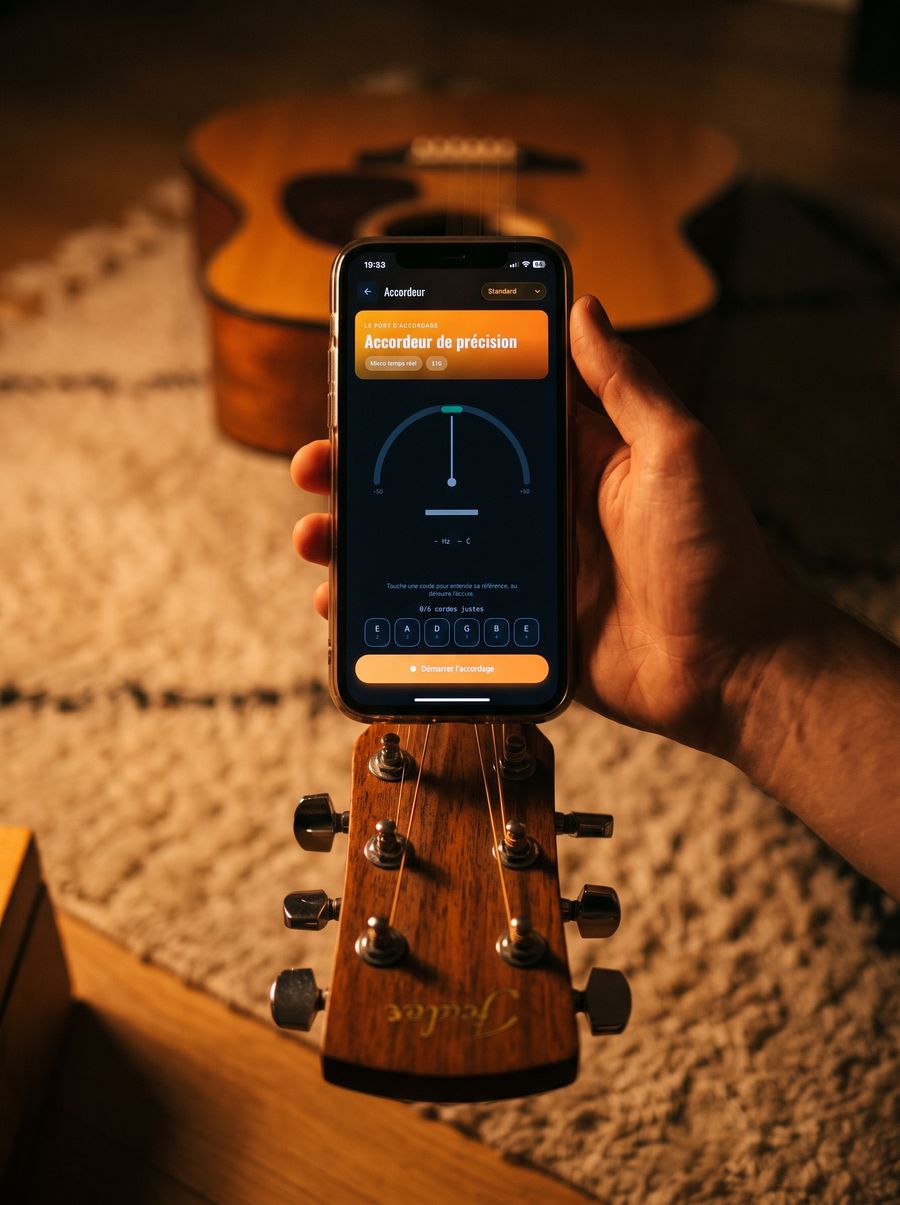
Precision tuner
Real-time detection through the microphone, accurate to a hundredth of a semitone, all six strings tracked one by one, alternative tunings included. Free for everyone.
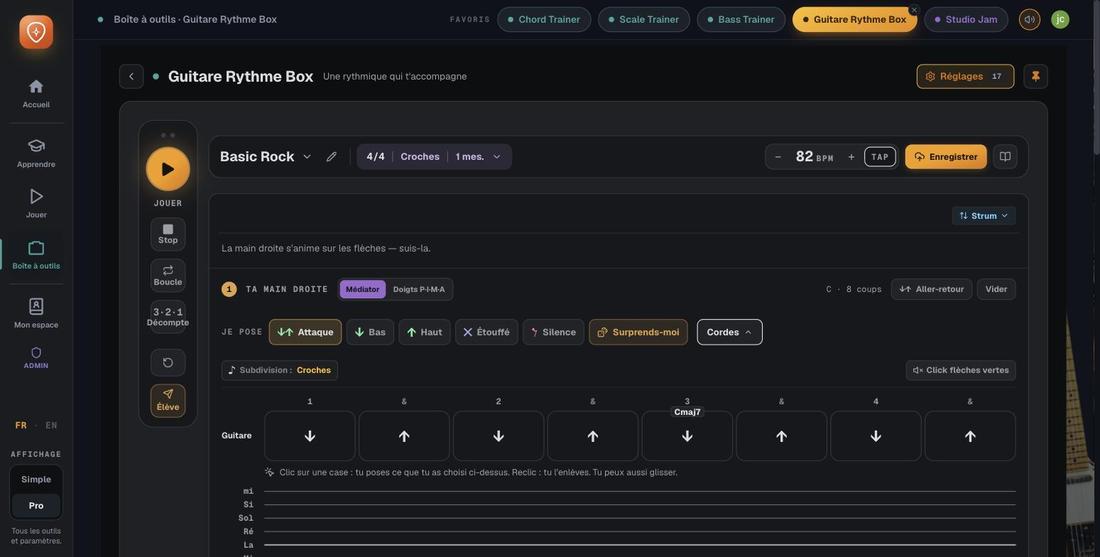
Guitare Rythme Box
The movement of the picking hand, arrow by arrow, in sync with the tempo — with a pick or with your fingers (thumb, index, middle, ring). You write your own strumming pattern stroke by stroke and you keep it. Drums, metronome, swing, time signatures, 19 grooves and 23 picking-hand patterns ready to use.
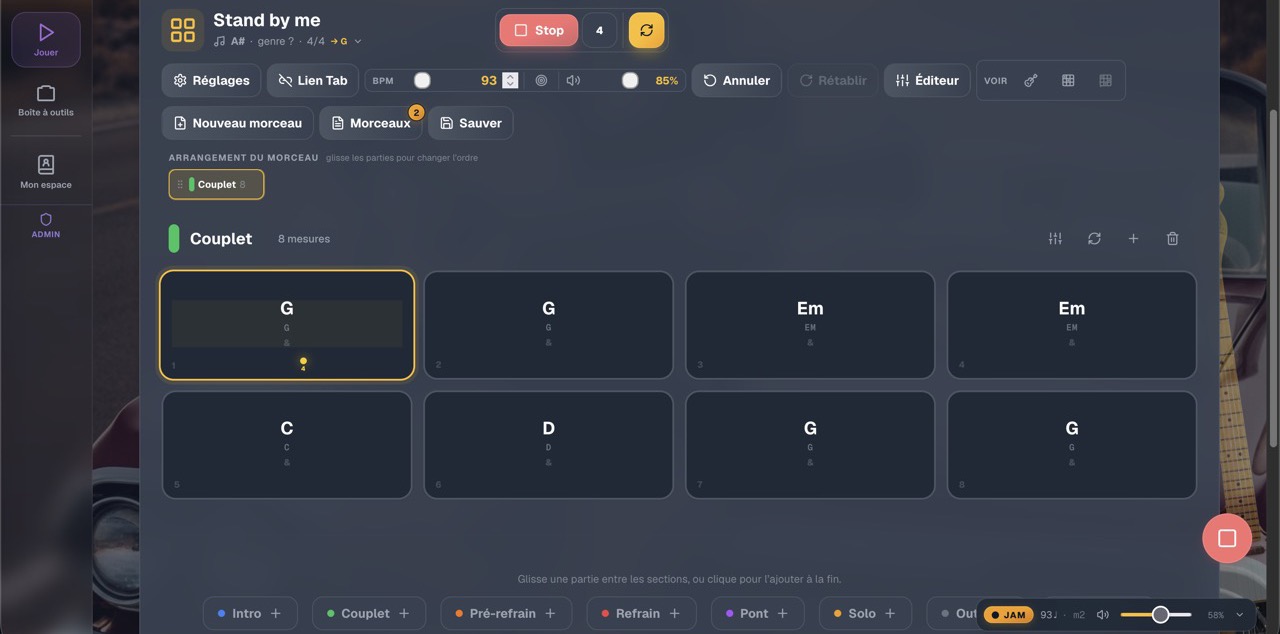
Studio Jam
Write your verse-chorus chord chart, set the tempo, and play over a real bass, drums and piano backing. The arrangement is dragged into place with the mouse.
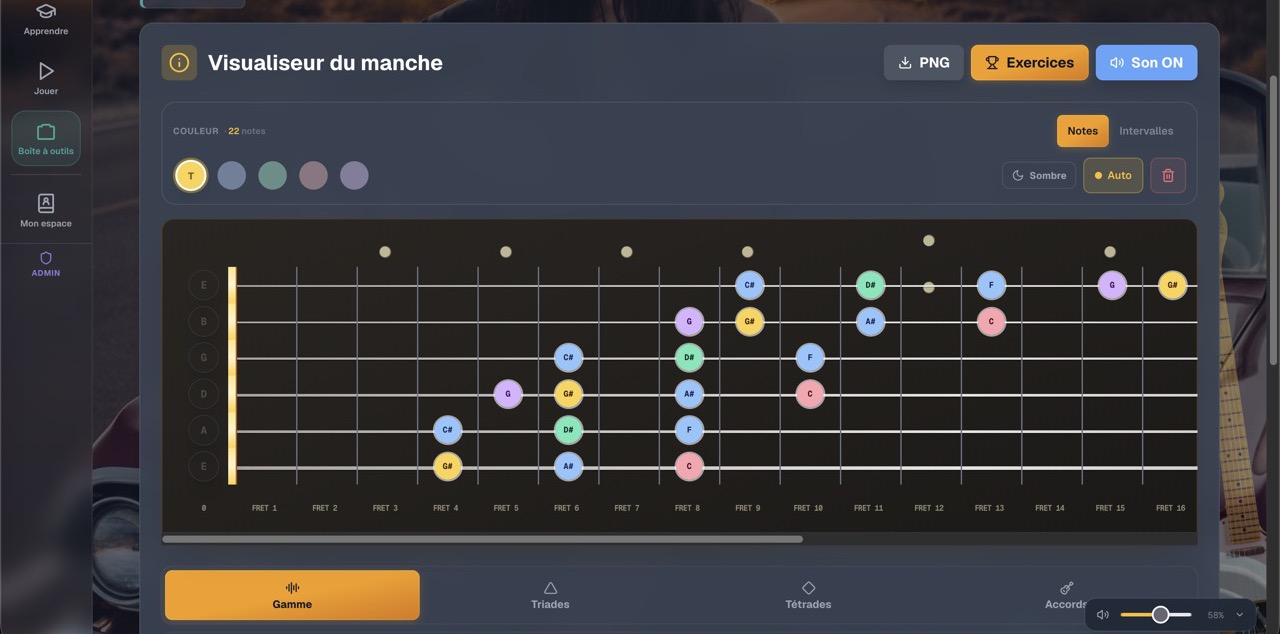
Fretboard explorer
Scales, triads, four-note chords and chords shown across the whole fretboard, as notes or as intervals, with the sound. For guitar, bass, ukulele and piano.
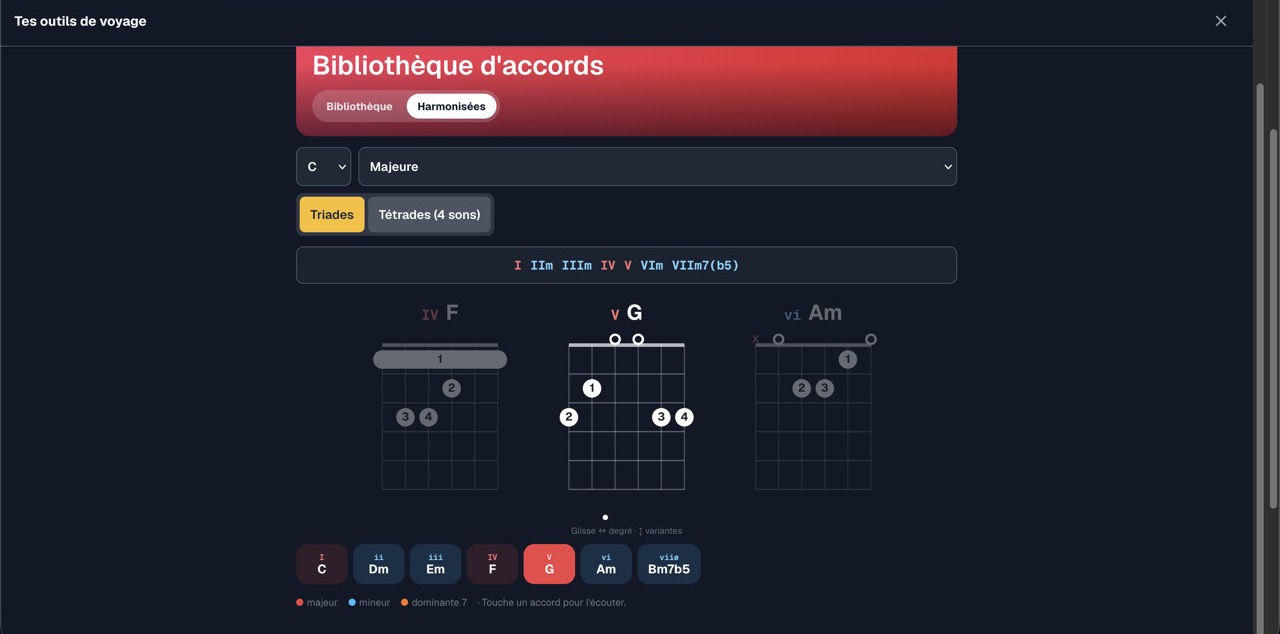
Chord library
113 chords in clear diagrams, played strummed or as arpeggios, with the harmonised chords for each key. Guitar, ukulele, banjo and piano.
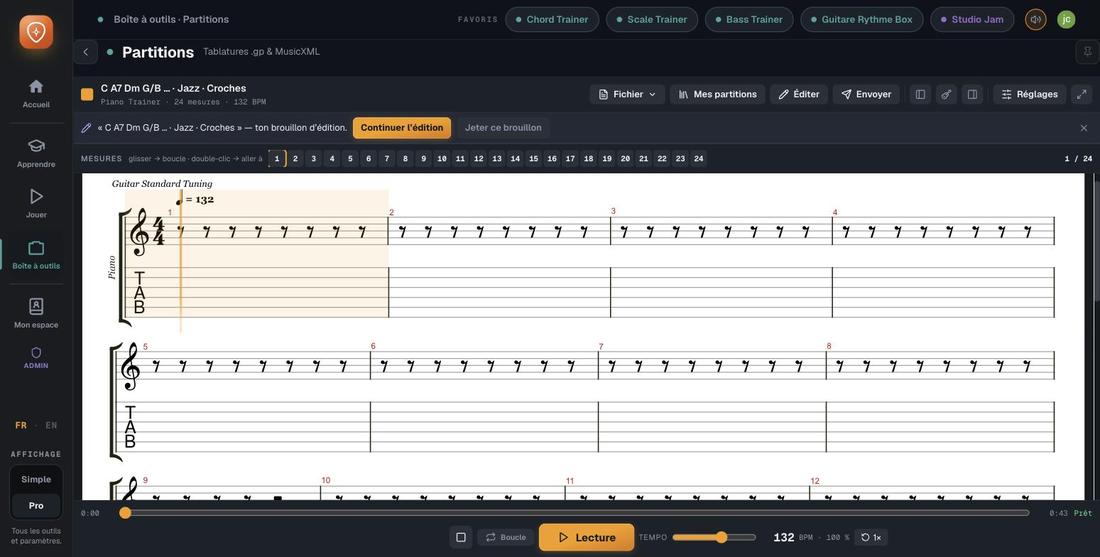
Tab player and editor
Open your Guitar Pro files, listen to them, follow the cursor, slow them down, loop a passage. And write your own tabs.
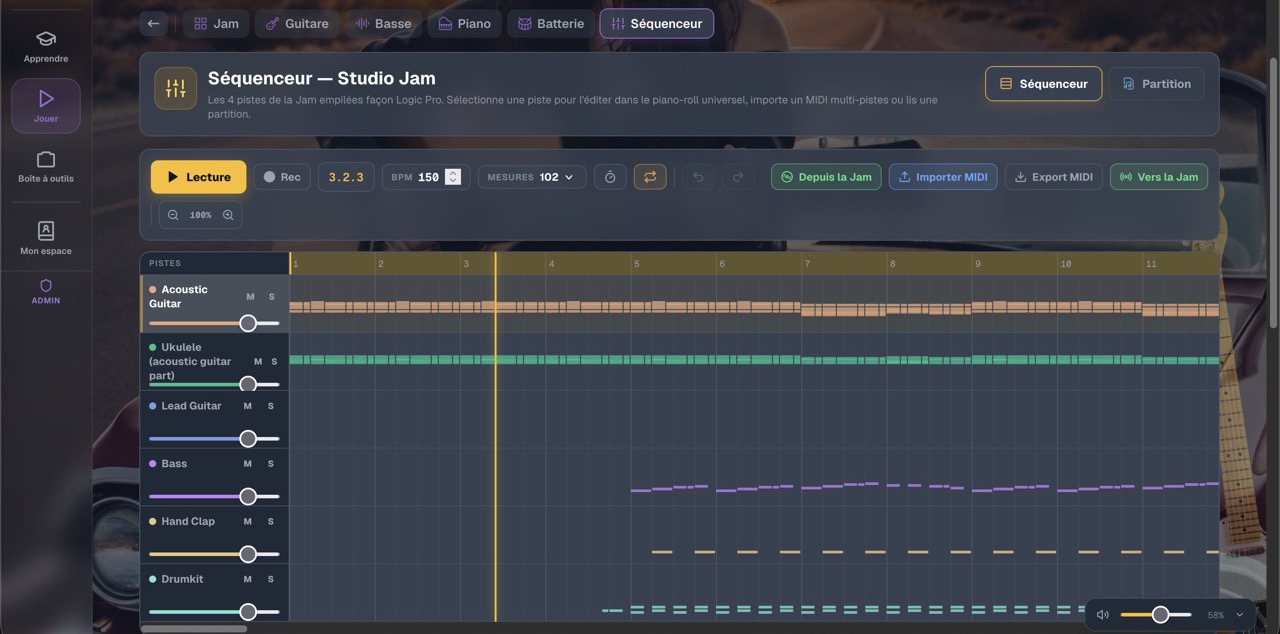
Drums and sequencer
Build your grooves square by square, or start from one of the existing patterns. Tempo, swing and dynamics are set down to the finest detail.
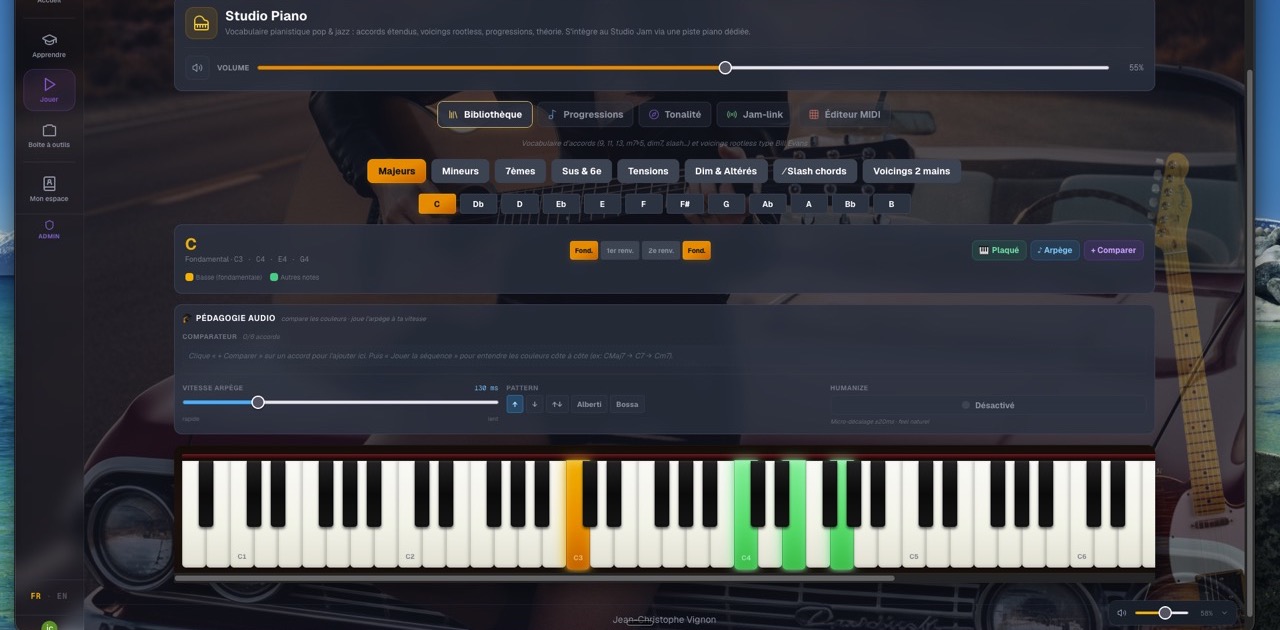
Piano studio
The backing piano follows your chord chart and changes the way it plays depending on the style. Useful for hearing the harmony somewhere other than on the guitar.
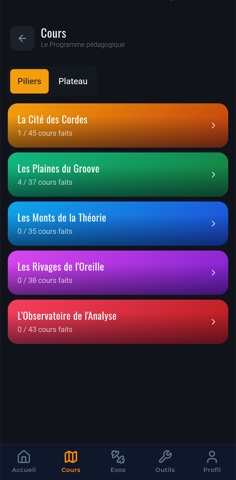
The guided programme
198 steps across five pillars, with enriched lessons, exercises and progress tracking. Plus the exercises I drop in after each lesson.
Learn — we guide you
- Teaching programme — 198 steps, five pillars
- Story mode — the same path, told as a story
- Theory — intervals, scales, chords, cadences
- Technique — fretting hand, picking hand, accuracy
- Ear training — 46 exercises, see below
- Rhythm — reading, composer, body rhythm
- Video lessons
- Chord coach — your chord changes checked through the mic
Play — your song
- Studio Jam — your chord chart, and a band that follows you
- Guitar Studio — strumming patterns, arpeggios, fingerpicking
- Bass Studio — voices, lines and presets
- Piano Studio — chords, voicings, progressions
- Drum Studio — grooves, kits and drummers
- Sequencer — all four tracks in a piano roll
- Looper — record a loop, play over it
- Backing tracks — play along to a backing track
- Recording studio — record yourself over the chord chart
Toolbox — grab it and go
- Tuner — string by string, accurate to a hundredth
- Metronome — the tempo, nothing else
- Guitare Rythme Box — a strumming pattern that plays along with you
- Virtual drum kit — the full kit, from your keyboard
- Chords — diagrams, inversions, arpeggios
- Scales and Fretboard — one fretboard for everything
- Scores — .gp and MusicXML files
- Tab editor — write a tab linked to the Jam
- Scale · Chord · Bass · Piano Trainer
- Sessions — string your exercises into a routine
And a whole room for the ear
46 of the app's 80 exercises are devoted to it. It's the pillar guitarists work on least — and the one that makes the difference between playing notes and making music.
Hearing
- Major or minor, with your eyes closed
- Six chord qualities on the same root — 7, m7, Maj7, m7♭5
- The basic intervals, and which one is bigger
- Identify a scale, then complete it
- Recognise the mode: Ionian, Dorian, Mixolydian…
- Recognise the cadence
- Spot the wrong note
Singing — through the mic
- Sing the note you have just heard
- Drone: sing each degree of the scale
- Vocal warm-up and holding a note
- Twelve guided vocal exercises : scales, thirds, fifths, octaves, major and minor arpeggios
- Sing the chords of the scale
- Your pitch is shown in real time while you sing
Playing what you hear
- Play back the melody you have just heard
- Melodic memory, getting longer and longer
- Find the note on the fretboard
- Octave Hunter: the same note, three positions
- Riff Match: play back a well-known riff
- Jam Coach: guess the key of what's playing
- Scale Runner and Speed Picking, controlled through the mic
Your guitar goes everywhere with you.
One account. Your songs, your scores and the exercises your teacher drops in follow you from one device to the next — with nothing to copy over. The pocket app carries the essential tools; the computer stays the full workshop.
-
On a computer, in the browser
Nothing to install. It's the most comfortable version for the jam studio, writing chord charts and working on tabs.
-
The tools, offline No internet
Tuner, drum machine, scales, chords, fretboard: everything works on the train, at rehearsal or at the bottom of the garden.
-
The lessons, online Connection required
Your songs, your scores, your exercises and your teacher's locker travel from one device to another. The detailed tracking of your progress, though, stays on the computer.
-
Nothing heavy to install
On iPhone as on Android, the app is added from the browser and then behaves like a real app.
Five pillars, 198 steps.
The app isn't only a toolbox: it also holds the complete programme, built on sixteen years of teaching and running to close to a hundred thousand words. Click a pillar to see what you work on there, step by step. (The written courses are currently in French; the interface is in English.)
↑ Click a pillar to see the programme in detail
Instrumental practice
45 lessons · The guitar in your hands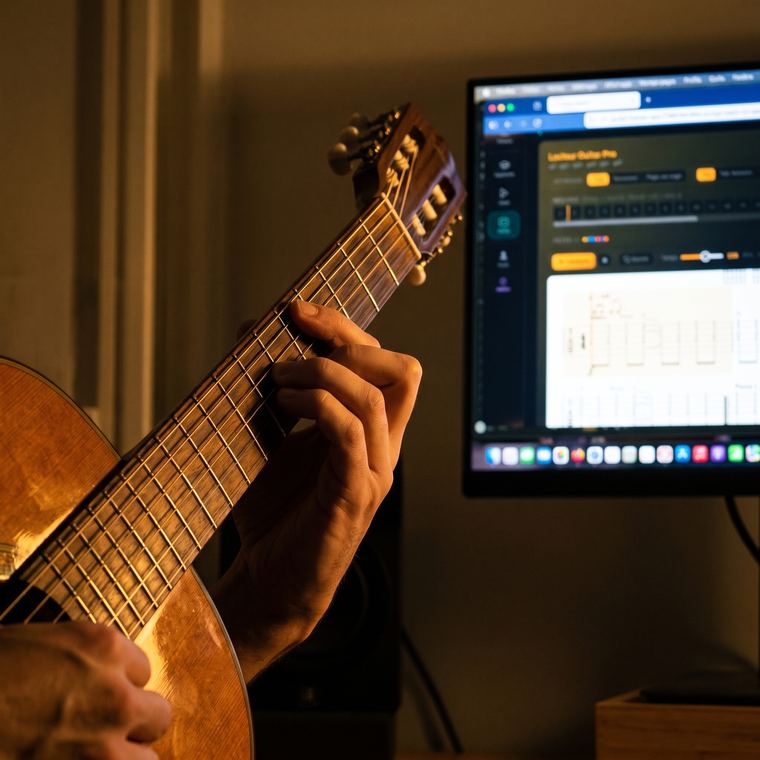
Everything you play with your fingers: holding the instrument, chords, the picking hand, melody, improvisation. It's the most visible pillar — and the one the other four rest on.
Getting started
- Posture, holding the pick, minimum pressure in the fretting hand
- The six open strings and tuning
- Reading tab (and why the rhythm isn't in it)
- Your first chords: Em, Am, then E, A, D
- First melodies on one or two strings
Progressing
- The 7 open chords, timed changes
- Picking hand with a pick: steady alternate picking
- Fingerpicking: alternating thumb, then Travis picking
- Your first full song, from start to finish
- The pentatonic scale, first position
Mastery
- Barre chords (F, Bm) and the CAGED system
- Palm muting, arpeggios, melody and bass at the same time
- The 5 pentatonic positions across the whole fretboard
- Your first improvised phrases
- Three-voice fingerstyle, fast picking
In the lesson itself: this is where I correct what no video can correct for you — the angle of your wrist, the pressure of your fingers, the movement that tires you out for nothing.
Rhythm work
37 lessons · Rhythm, in the body first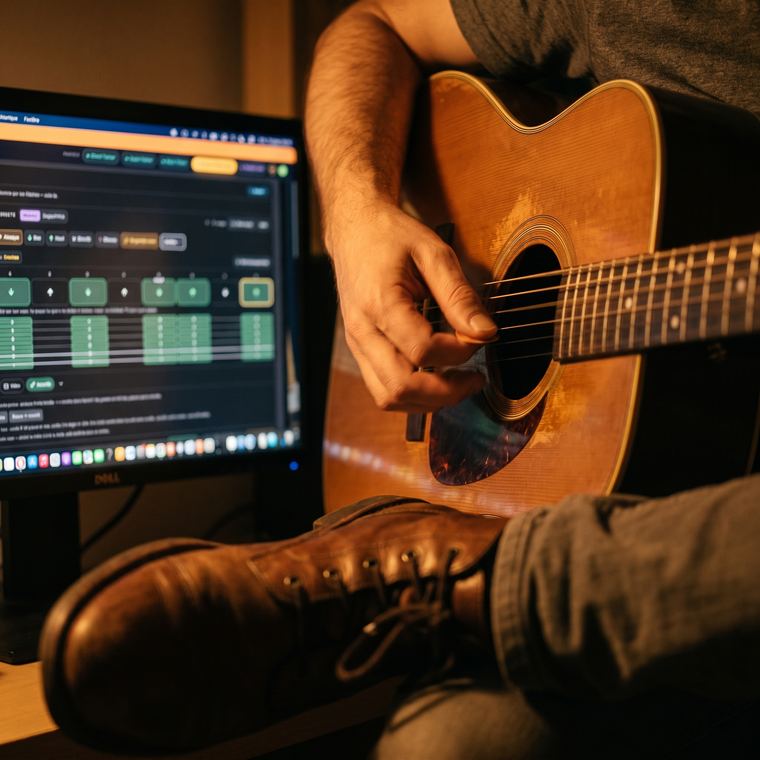
The most neglected pillar, and by far the most decisive. Three chords placed well sound better than twenty chords left floating — and it's the first thing people hear when they listen to you.
Getting started
- Feeling the pulse, tapping your foot, counting out loud
- Finding the downbeat — the famous “1”
- First contact with the metronome (and why it annoys you)
- Quarter notes, eighth notes and changes of density
- First strumming: the wrist as a pendulum
Progressing
- The essential patterns, starting with D-DU-UDU
- Sixteenth notes and accents
- The backbeat: the accent on 2 and 4, the thing that makes people dance
- Muted strings and percussive playing
- Playing over a backing track, locking in with the bass
Mastery
- Syncopation and offbeats, funk and reggae patterns
- Shuffle and triplets: the blues feel
- Writing and varying your own rhythm patterns
- Internal tempo: playing in time without a metronome
- The pocket: playing slightly behind the beat, with a band
In the lesson itself: we often work on rhythm without a guitar before picking it back up. If it doesn't work in your hands, it won't work on the instrument.
Music theory
35 lessons · Understanding what you play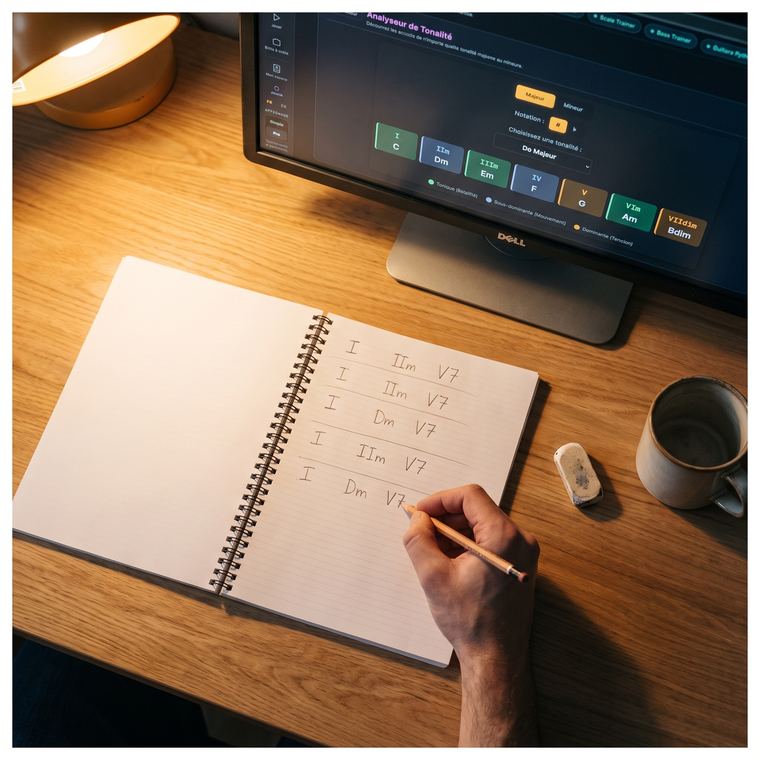
Always applied to the fretboard, never abstract: every idea is played straight away. No music reading forced on you — understanding why a chord sounds the way it does doesn't require reading a stave.
Getting started
- The 7 notes, in French and in international notation
- Frets, semitones, tones, sharps and flats
- Intervals seen on the fretboard (the fifth, the octave…)
- The notes on the E and A strings: your landmarks
Progressing
- The major scale and its tone-tone-semitone formula
- The natural minor scale, treated with the same care
- The pentatonic = a scale minus two notes
- The notes on the four high strings
Mastery
- Harmonising the scale: triads, degree by degree
- Seventh chords and their four colours
- Cadences and progressions: I-IV-V, I-V-vi-IV, V-I
- The 5 CAGED positions, the useful modes, the II-V-I
In the lesson itself: theory never turns up on its own. It turns up when it explains something you already play — that's when it becomes useful rather than boring.
Developing your ear
38 lessons · Hearing before playing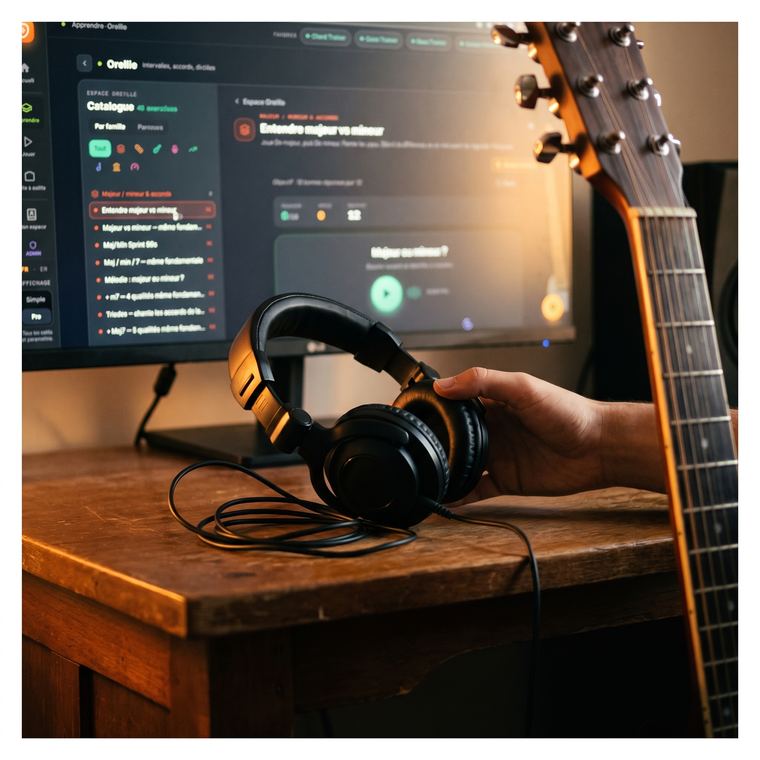
The pillar that varies most from one person to the next — so the one we never rush. And yet it's what separates playing notes from making music.
Getting started
- Low or high: the very first distinction
- Active listening: hearing the bass, the vocals and the guitar separately
- Singing or humming what you play
- Tuning by ear by listening to the beats
Progressing
- Three fundamental intervals: octave, fifth, third
- Major or minor: recognising the colour with your eyes closed
- Finding the key of a song
- Your first transcription: a simple melody, with no tab
Mastery
- Seven intervals recognised by ear
- Recognising chords and hearing the V→I resolution
- Working out a song's chords by ear
- Recognising scales and common progressions
In the lesson itself: a few minutes every session, never hours. The ear is built in small regular touches, not in intensive blocks.
Musical analysis
43 lessons · Styles and your musical identity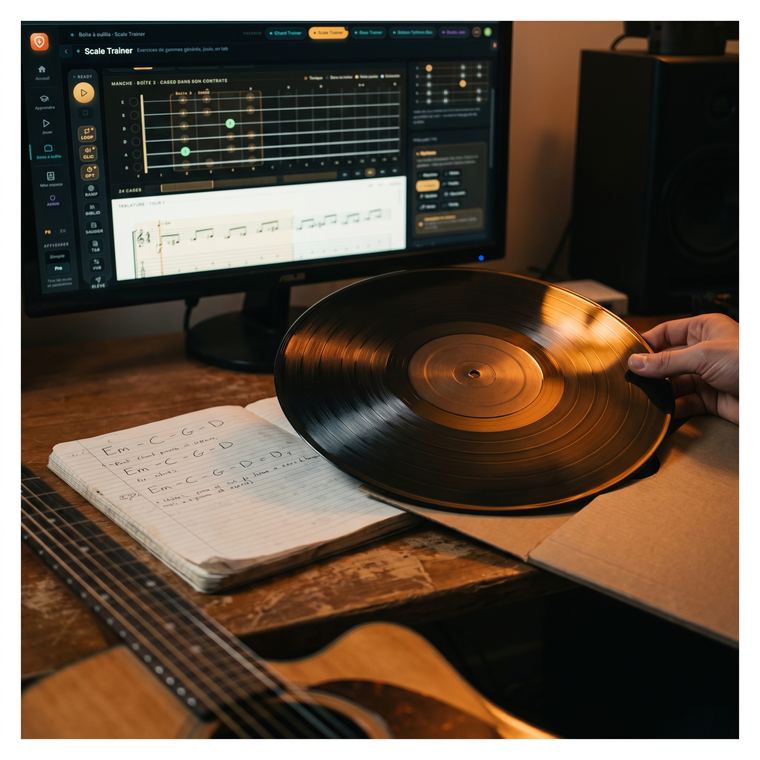
Where everything else comes together: listening to a song and understanding how it's built, playing the major styles, building a repertoire — and finally finding your own sound.
Getting started
- Listening to a style and spotting what defines it
- Your first song, chosen by you
- Rock and acoustic folk: two opposite approaches
- Recording yourself and listening back — the most underused tool there is
Progressing
- Blues: 12 bars, shuffle, your first two-note solo
- Folk and pop: the I-V-vi-IV progression and the capo
- Rock: power chords, iconic riffs, palm muting
- Building a repertoire of 3 to 5 songs played all the way through
Mastery
- Advanced blues: licks, bends, call & response
- Fingerstyle and arrangements of your own
- Funk, classic rock, jazz fundamentals
- Writing, recording, finding your musical identity
In the lesson itself: you're the one who brings the songs. We start from what you love listening to — motivation is a teaching tool, not a detail.
You take lessons with me
The app is included, at no extra charge, in any month you take a lesson. But the point isn't the price: it's that the lesson and the app are one and the same thing.
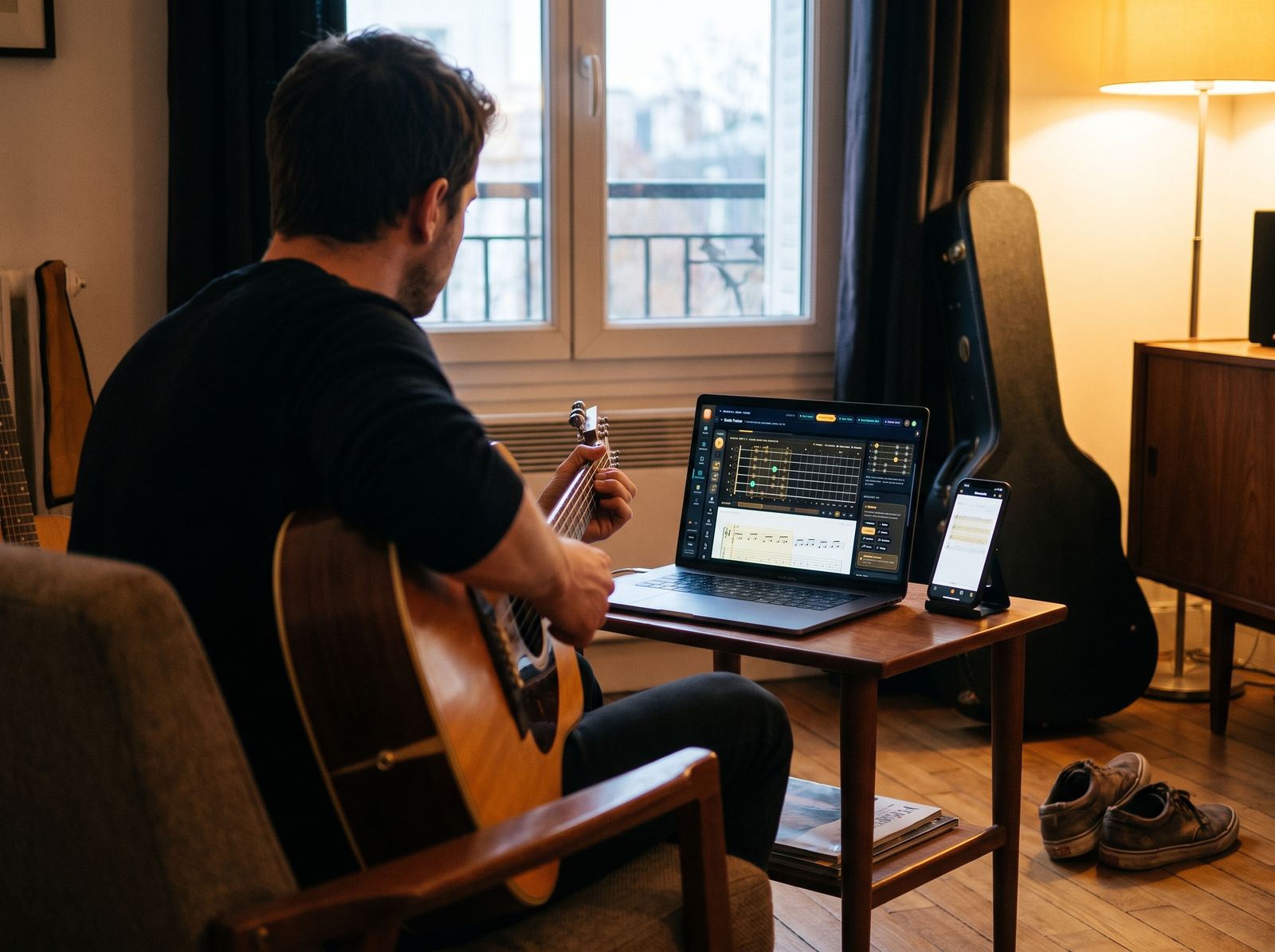
- The lesson takes place inside the app — a "Join" button appears in your space at the agreed time. No Zoom, no link to hunt for.
- We look at the same screen — whatever tool I open on my side opens on yours: diagrams, rhythm box, fretboard, tab.
- Your exercises are waiting — in your locker before the session ends: the chart, the strumming pattern, the scale exercise, the tab.
- I can see what you've practised — your progress comes back to my teacher's space. No more losing ten minutes taking stock.
- Annotated videos — I can send you a time-stamped demonstration, or comment on a recording you send me.
You are a guitar teacher
This app came out of a gap: I couldn't find what I wanted to leave with my students between lessons, so we built it. If you teach, you know the problem: the student leaves with three scribbled notes, and the following week you discover they've been practising it wrong. Guitar Master is opening up to independent teachers.
- Your own teacher's space — your students, their progress, what they've worked on during the week. Your space, your students: I have no access to it.
- Your locker — drop in a chord chart, a strumming pattern, a scale exercise, a tab, an annotated video. Fourteen kinds of item.
- Full access for you and your students — all 24 tools, the four trainers, the studio, the Rythme Box, the tab reader.
- The 198-step programme — use it as the backbone of your own teaching, or ignore it completely and use only the tools.
- Video lessons inside the app — the session happens in the tool, and whatever you open opens on your student's screen.
What it changes, very concretely: your student no longer practises in silence from unreadable notes, and you no longer start every lesson with an investigation.
Teacher plan
For an independent guitar teacher and their students.
Up to 35 active students · No commitment
- 1 teacher's space in your name
- 35 active students at a time — remove one, add another
- Full access for you and for them
- First month free at launch
The multi-teacher space is still being built. I'll let everyone on the list know the moment it opens, and the first partner teachers will be onboarded one at a time — I'd rather say that plainly than sell you a service I can't deliver yet.
What each one gets.
A core set of tools stays free for everyone, with no paid account and no card details. The rest depends on your situation.
| FreeFor everyone | App only€14.99/month | My studentIncluded | Teacher€69/month | |
|---|---|---|---|---|
| Tuner, metronome, chords, fretboard | ✓ | ✓ | ✓ | ✓ |
| Drum sequencer and looper | ✓ | ✓ | ✓ | ✓ |
| Studio Jam — the band that plays behind you | Limited version | ✓ | ✓ | ✓ |
| The four trainers (scales, chords, bass, piano) | — | ✓ | ✓ | ✓ |
| Guitare Rythme Box — the picking hand | — | ✓ | ✓ | ✓ |
| Studio Lab — plug your guitar in, eleven amps | — | ✓ | ✓ | ✓ |
| Studio Tab — Guitar Pro reader and editor | — | ✓ | ✓ | ✓ |
| The 198-step programme and the 80 exercises | — | ✓ | ✓ | ✓ |
| Mobile app, tools offline | ✓ | ✓ | ✓ | ✓ |
| Exercises sent by a teacher | — | — | ✓ | You send them |
| Video lessons inside the app | — | — | ✓ | ✓ |
| Your own teacher's space | — | — | — | ✓ |
| Up to 35 active students | — | — | — | ✓ |
| €0Available | €14.99Opening soon | IncludedFrom €20 a lesson | €69Opening soon |
← Swipe the table →
The "app only" subscription and the teacher plan aren't open yet: payment and the multi-teacher spaces are still being built. Leave me your email address and I'll let you know at launch.
The app: your questions.
What is the Guitar Master app?
An app for learning guitar, on computer and on your phone, from complete beginner to advanced player. It brings together 24 tools — tuner, metronome, Guitare Rythme Box, virtual drums, chords, scales, fretboard, scores, tab editor, Studio Jam, guitar / bass / piano / drum studios, sequencer, looper, recording studio, chord coach — and four trainers that build your exercises and write them out in tab: Scale Trainer, Chord Trainer, Bass Trainer and Piano Trainer. On top of all that, a guided 198-step programme. It is developed by Solfia Édition and designed with Jean-Christophe Vignon, a guitar teacher, out of sixteen years of teaching.
What are the four trainers for?
They solve the problem of practising alone: what to play today, and how. You write in the chord chart for your song, and the app shows you what to play over it. The Scale Trainer generates the scale that fits each chord, or the arpeggio of the chord itself. The Chord Trainer handles chords — triads, open, barre, jazz, cadences, arpeggios — choosing the shapes that flow best into one another. The Bass Trainer writes a bass line in sixteen styles (pop, rock, blues, jazz, funk, soul, reggae, gospel, bossa…) and the Piano Trainer does the same on piano, in eighteen styles. Every exercise plays back, appears on the fretboard and is written out in tab — and I can send you one after a lesson.
How do you work on your ear in the app?
It's the biggest part of the app: 46 of the 80 exercises are devoted to it. First, hearing — major or minor, six chord qualities on the same root, intervals, scales, modes, cadences, the wrong note. Then singing, with the microphone showing how in tune you are in real time : singing back the note you hear, singing each degree over a drone, twelve guided vocal exercises, singing the chords of the scale. And finally playing back what you hear on the guitar: melodic memory, finding a note on the fretboard, copying a riff, guessing the key. Ear training works in small, regular doses, not in three-hour blocks — each exercise takes five minutes.
Do I need to create an account?
Yes. Your account is what keeps your progress and your exercises with you from one device to the next. Signing up takes a minute, by email or with a Google account. If you just want to see what it looks like first, the demo needs no account at all.
How much does the app cost?
A core set stays free for everyone: the tuner, the metronome, the chord library, the fretboard explorer, the drum sequencer, the looper and the studio jam in a limited version. Full access is €14.99 a month with no commitment — and it opens soon. It's included at no extra charge for students taking lessons, in the month of their lesson. Guitar teachers have a plan of their own at €69 a month.
What devices does it work on?
On a computer, straight in the browser, with nothing to install. And on iPhone and Android, where you add the app from the browser and it then behaves like a real app. Your songs, your scores and the exercises your teacher sends follow your account from one device to the next; detailed progress tracking lives on the computer.
Does the mobile app work offline?
The tools — tuner, drum machine, scales, chord library, fretboard explorer — work offline: you can practise on the train, on holiday or at rehearsal. Lessons, your student locker and your songs need a connection, and detailed progress tracking lives on the computer.
I'm a guitar teacher. When can I sign up?
The multi-teacher space is still being built: today the app can only follow the students of one teacher — me. Join the waiting list and I'll let you know when it opens. The first partner teachers will be onboarded one at a time, with the first month free. I'd rather tell you that plainly than take a subscription for a service I can't deliver yet.
What exactly does "35 active students" mean?
Thirty-five students in your space at the same time. If one stops, you remove them and add someone else in their place — there's no monthly counter to keep an eye on. Beyond thirty-five, we'd talk: it makes no sense to charge an individual teacher what a school would pay.
Is the app in English?
The interface is: the whole tool switches to English in one click. The five written programmes — close to a hundred thousand words — are for now in French only, and their translation is planned. In other words, an English-speaking guitarist can use every tool and every exercise, but will read the courses in French.
Is my students' data kept separate from yours?
Yes. Each teacher has their own space: their students, what they send them, their progress. I have no access to the teaching material you put in it, nor to your students' progress.
Guitar Master, an app for learning guitar, designed with a teacher.
Guitar Master is an app for learning guitar, on computer and on mobile, from the complete beginner to the experienced player. It is developed by Solfia Édition and designed with Jean-Christophe Vignon, a guitar teacher trained at the ATLA school of contemporary music in Paris and at the Jazz and Contemporary Music course of the Amiens conservatoire — for his own students first. You can use it alone, alongside one-to-one lessons over video, or as another guitar teacher with your own students.
A teacher's app, built like a piece of software
Guitar Master brings together twenty-four tools that guitarists actually use: a precision tuner accurate to a hundredth of a semitone, a metronome, the Guitare Rythme Box with the picking hand animated stroke by stroke, virtual drums, a library of 113 chords, scales and intervals, fretboard exploration, a Guitar Pro-compatible tab reader and editor, a jam studio with bass, drums and piano backing, per-instrument studios, a piano-roll sequencer, a looper and a recording studio. All of it is backed by a guided 198-step programme, built on sixteen years of teaching.
Write your chord chart, and the app shows you what to play over it
This is the newest part of the app, and what really sets it apart. You lay out the chords of your song, and four generators build what there is to play over the top, play it back, show it on the fretboard and write it out in tab.
The Scale Trainer is an automatic scale and arpeggio generator over the chords of your song: it suggests the scale that fits each chord, the arpeggio of the chord itself, or the scale of the whole song from start to finish. The Chord Trainer handles chords — triads, open chords, barre chords, jazz chords, cadences such as the ii-V-I, and arpeggios — choosing each time the shape that flows best from the one before. The Bass Trainer is an automatic bass line generator in sixteen styles: pop, rock, ballad, blues, jazz, country, funk, soul, disco, reggae, gospel, bossa, neo-soul, metal, electronic and cinematic, with thirty-seven sub-styles. The Piano Trainer does the same for piano in eighteen styles, with the left and right hands written separately on two staves. Every exercise can be saved, played back, and sent to a student by their teacher.
Forty-six exercises for the ear
The ear is the pillar guitarists work on least, and the one that separates playing the notes from making music. The app gives it 46 of its 80 exercises, in three families. Hearing : major or minor, six chord qualities compared on the same root, intervals, identifying and completing a scale, recognising modes and cadences, spotting the wrong note. Singing, with the microphone showing your pitch accuracy in real time: singing back the note you hear, singing each degree over a drone, twelve guided vocal exercises on scales, thirds, fifths, octaves and arpeggios. Playing back what you hear on the guitar: melodic memory, finding a note on the fretboard, octaves, copying a riff, guessing the key. Each exercise takes five minutes, because the ear is built in regular small doses.
An app for every level
Complete beginners find the tuner, open chords, picking-hand rhythm and a programme that tells them what to do next. Intermediate players work on barre chords, the pentatonic across the whole fretboard, the ii-V-I and playing over a backing. Advanced players find voicings with tensions, walking bass, two-handed comping, four-instrument arranging and Guitar Pro export. The advanced settings are all there without ever getting in the way: every trainer starts on a level that's ready to use.
On your computer, with the essential tools in your pocket
The app runs in your browser on a computer, with no installation, and adds itself to the home screen on iPhone and Android. On the phone, the essential tools stay usable offline; your songs, your scores and your teacher's exercises follow your account from one device to the next.
For independent guitar teachers
Any teacher knows the problem: the student leaves with three scribbled notes and comes back a week later having practised it wrong. Guitar Master's teacher plan opens a teacher's space in your name, with your own locker — fourteen kinds of item: chord charts, strumming patterns, scale exercises, tabs, time-stamped annotated videos — a view of what each student has actually worked on, and full access to the app for you and up to thirty-five active students at a time, at €69 a month with no commitment. The 198-step programme can serve as the backbone of your teaching or stay out of the way: the tools work independently. This plan opens soon; for now, sign-up is through the waiting list.
A private lesson, not a video library
For those who want to move faster, every video session is a genuine one-to-one lesson: your teacher watches you play, corrects your posture and your picking hand, and adapts the content to your level, your style and your goals. The lesson takes place inside the app itself — no software to install, no link to hunt for, no account to create on a third-party service: a “Join” button appears in your account at lesson time, and the tool your teacher opens on their side opens on your screen too. Complete beginner, returning player or intermediate looking to break through a plateau: the programme is built for you, not for the average student. Your exercises are placed in the app at the end of every lesson, and prices are pay as you go, with no subscription: €20 for 30 minutes, €30 for 45 minutes, €40 an hour.
How much does the app cost?
A core set stays free for everyone, with no paid account: the precision tuner, the metronome, the chord library, the fretboard explorer, the drum sequencer, the looper and the studio jam in a limited version. Full access — the four trainers, the Guitare Rythme Box, Studio Lab, Studio Tab, the 198-step programme and the 80 exercises — is €14.99 a month with no commitment, and opens soon. It is included at no extra charge for students taking lessons over video, in the month of their lesson. Guitar teachers have a plan of their own at €69 a month, with their own space and up to 35 students.
Is the app available in English?
The interface is, entirely: menus, tools, exercises and settings all switch to English. The five written programmes that make up the 198-step pathway — close to a hundred thousand words — are for the moment written in French, and their translation is planned. So an English-speaking guitarist or teacher can use every tool, but will read the written courses in French.
Plug in.
The core tools are free and will stay free. For the rest — the trainers, the studio, the programme — leave me your email address and I'll let you know at launch. And if you'd rather have someone in front of you, lessons over video are pay as you go, from €20.