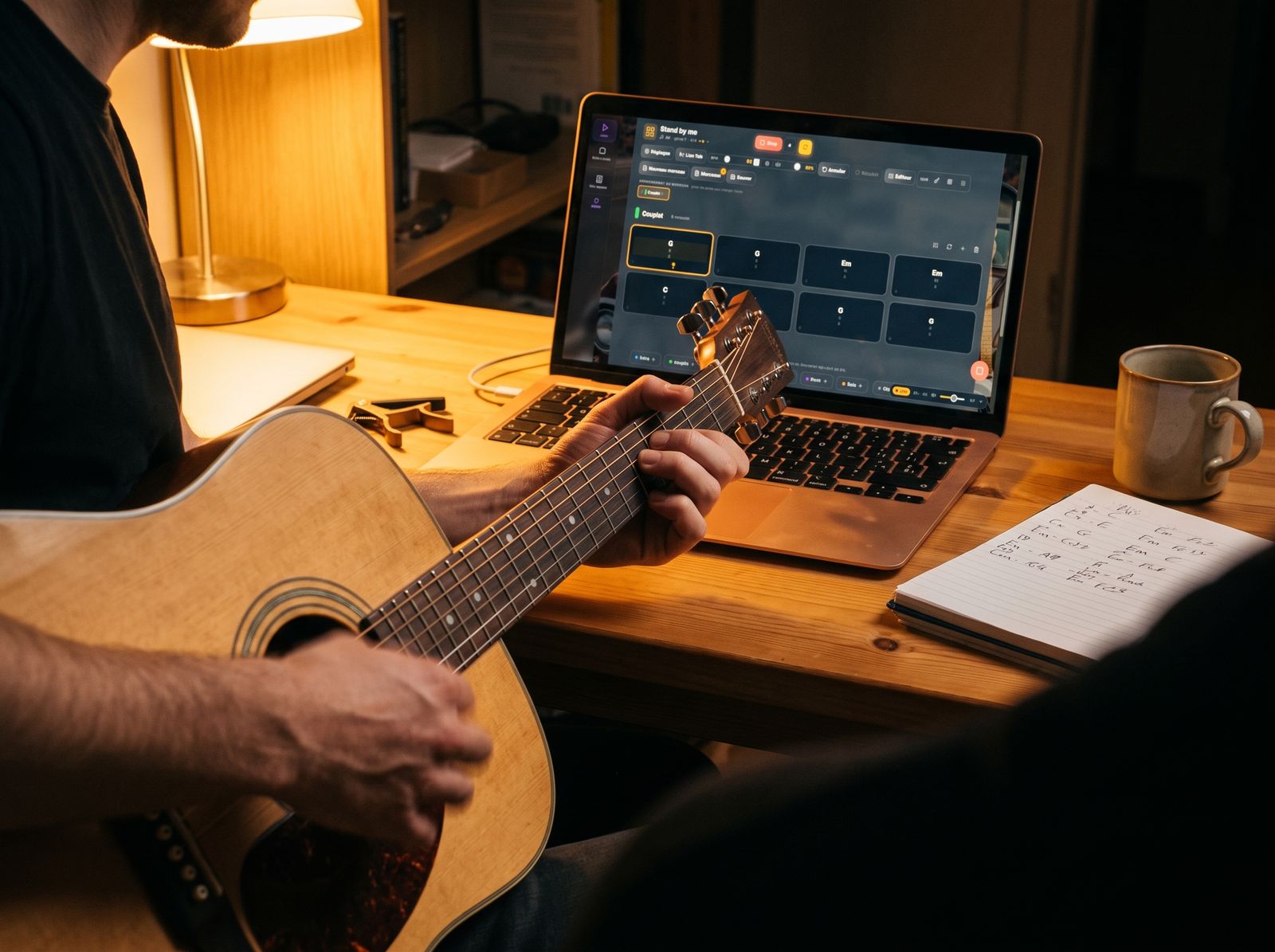
At last, a tool built
to help you get better.
Built for the guitarist practising alone at home: Guitar Master tells you what to work on, writes your exercises, and plays behind you. Lessons over video on top, if you want them.
One-to-one
guitar lessons.
Over video.
Teaching built over sixteen years of lessons, by someone who still teaches every day. No compulsory sight-reading, no generic video to watch on your own: we start from what you actually want to play, and repair whatever is getting in the way. Between sessions you keep Guitar Master — the app I built for my students, for want of finding it anywhere else.
Not sure yet? A free fifteen-minute call, no guitar needed — just to work out where you stand.
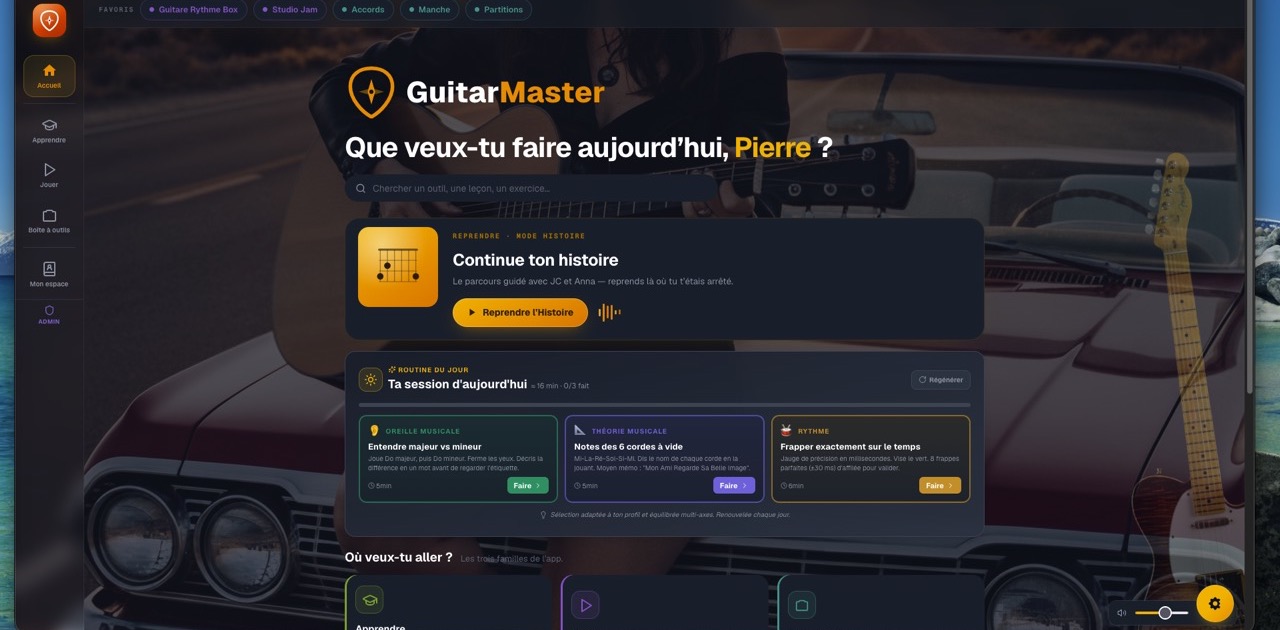
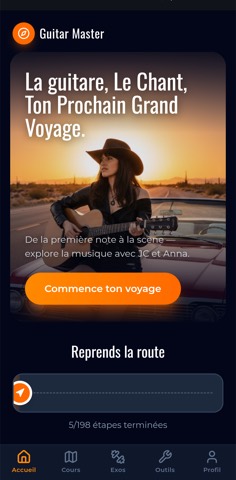
Already one of my students?
Your app hasn't changed — only the address you use to get to it. Log in with your usual details: your exercises, your lessons and your progress are waiting for you. Do bookmark this page.
Five pillars, one path.
A guitar lesson isn't a string of songs learnt by heart. These are the five lines along which I build each student's progress — and which the app turns into 198 steps so you can carry on alone.
↑ Click a pillar to see the programme in detail
Instrumental practice
45 lessons · The guitar in your hands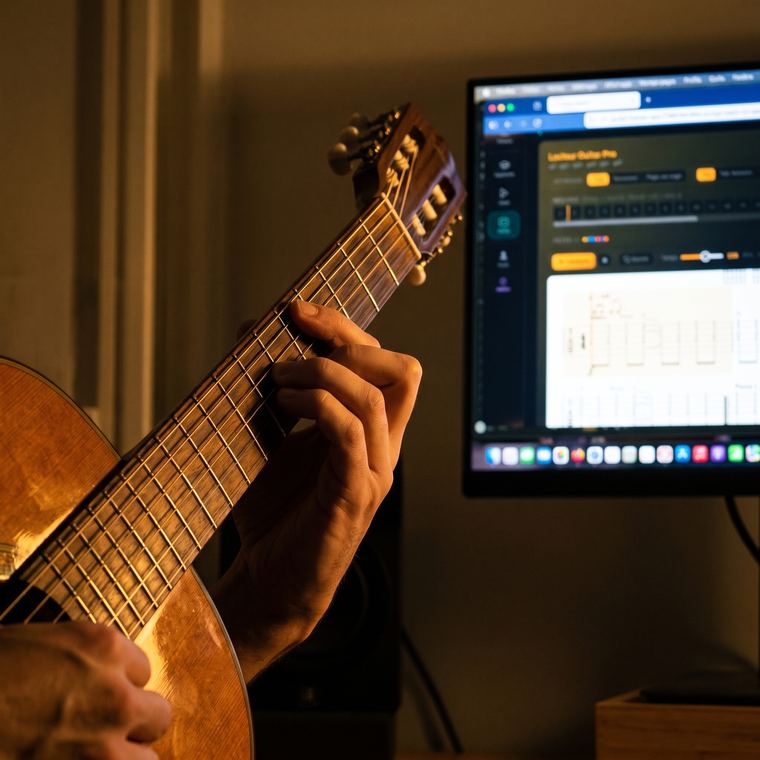
Everything you play with your fingers: holding the instrument, chords, the picking hand, melody, improvisation. It's the most visible pillar — and the one the other four rest on.
Getting started
- Posture, holding the pick, minimum pressure in the fretting hand
- The six open strings and tuning
- Reading tab (and why the rhythm isn't in it)
- Your first chords: Em, Am, then E, A, D
- First melodies on one or two strings
Progressing
- The 7 open chords, timed changes
- Picking hand with a pick: steady alternate picking
- Fingerpicking: alternating thumb, then Travis picking
- Your first full song, from start to finish
- The pentatonic scale, first position
Mastery
- Barre chords (F, Bm) and the CAGED system
- Palm muting, arpeggios, melody and bass at the same time
- The 5 pentatonic positions across the whole fretboard
- Your first improvised phrases
- Three-voice fingerstyle, fast picking
In the lesson itself: this is where I correct what no video can correct for you — the angle of your wrist, the pressure of your fingers, the movement that tires you out for nothing.
Rhythm work
37 lessons · Rhythm, in the body first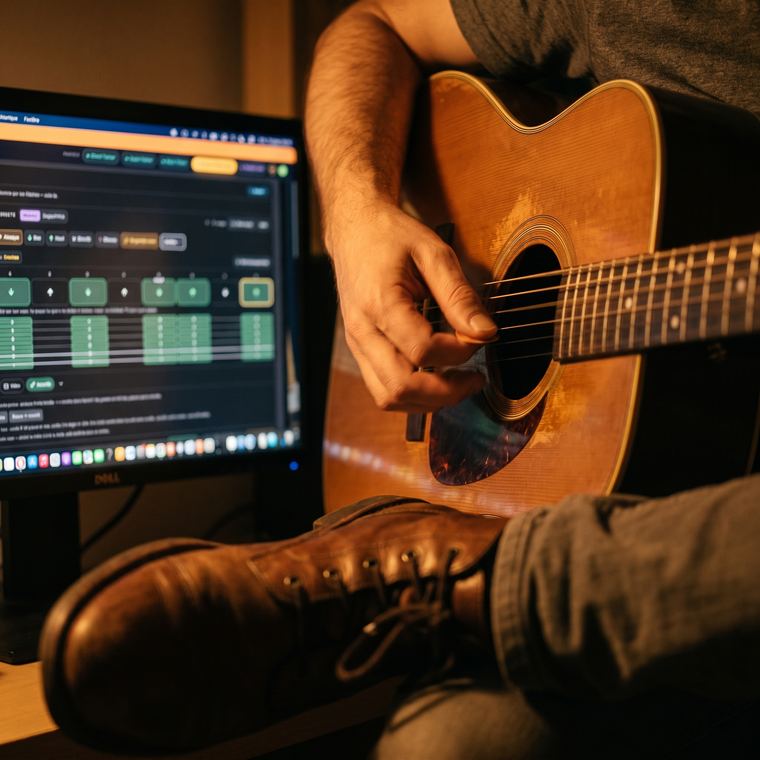
The most neglected pillar, and by far the most decisive. Three chords placed well sound better than twenty chords left floating — and it's the first thing people hear when they listen to you.
Getting started
- Feeling the pulse, tapping your foot, counting out loud
- Finding the downbeat — the famous “1”
- First contact with the metronome (and why it annoys you)
- Quarter notes, eighth notes and changes of density
- First strumming: the wrist as a pendulum
Progressing
- The essential patterns, starting with D-DU-UDU
- Sixteenth notes and accents
- The backbeat: the accent on 2 and 4, the thing that makes people dance
- Muted strings and percussive playing
- Playing over a backing track, locking in with the bass
Mastery
- Syncopation and offbeats, funk and reggae patterns
- Shuffle and triplets: the blues feel
- Writing and varying your own rhythm patterns
- Internal tempo: playing in time without a metronome
- The pocket: playing slightly behind the beat, with a band
In the lesson itself: we often work on rhythm without a guitar before picking it back up. If it doesn't work in your hands, it won't work on the instrument.
Music theory
35 lessons · Understanding what you play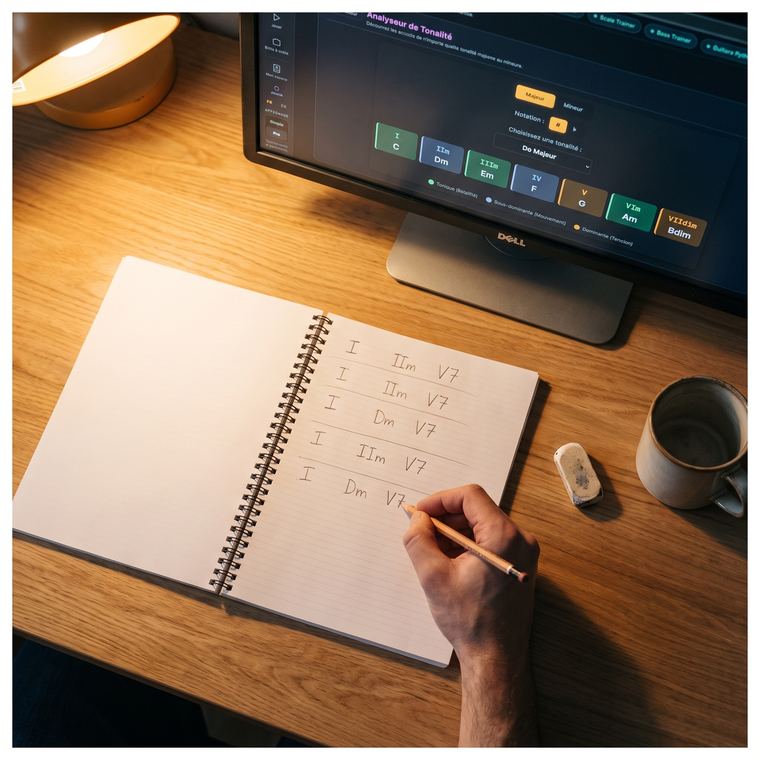
Always applied to the fretboard, never abstract: every idea is played straight away. No music reading forced on you — understanding why a chord sounds the way it does doesn't require reading a stave.
Getting started
- The 7 notes, in French and in international notation
- Frets, semitones, tones, sharps and flats
- Intervals seen on the fretboard (the fifth, the octave…)
- The notes on the E and A strings: your landmarks
Progressing
- The major scale and its tone-tone-semitone formula
- The natural minor scale, treated with the same care
- The pentatonic = a scale minus two notes
- The notes on the four high strings
Mastery
- Harmonising the scale: triads, degree by degree
- Seventh chords and their four colours
- Cadences and progressions: I-IV-V, I-V-vi-IV, V-I
- The 5 CAGED positions, the useful modes, the II-V-I
In the lesson itself: theory never turns up on its own. It turns up when it explains something you already play — that's when it becomes useful rather than boring.
Developing your ear
38 lessons · Hearing before playing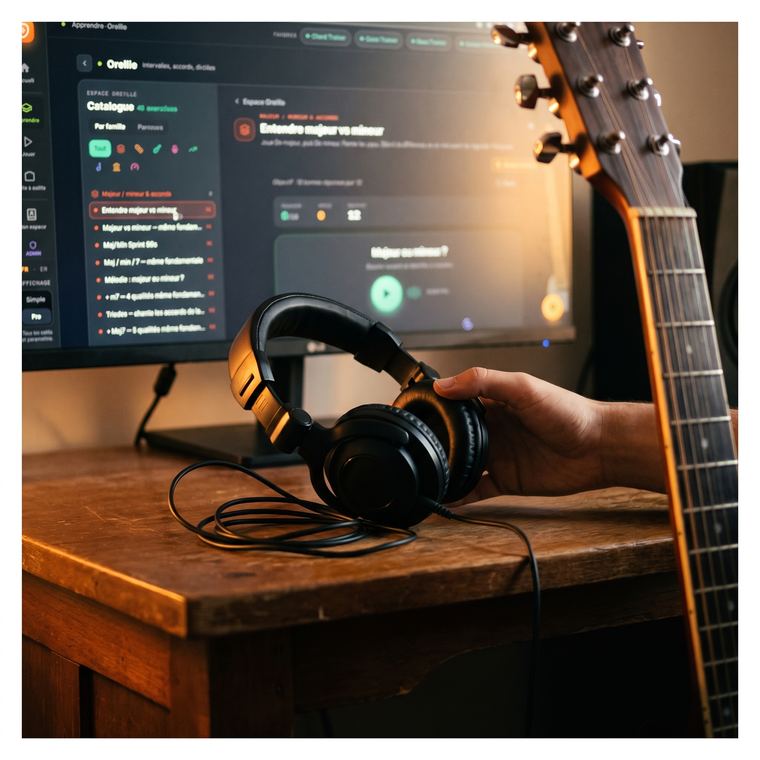
The pillar that varies most from one person to the next — so the one we never rush. And yet it's what separates playing notes from making music.
Getting started
- Low or high: the very first distinction
- Active listening: hearing the bass, the vocals and the guitar separately
- Singing or humming what you play
- Tuning by ear by listening to the beats
Progressing
- Three fundamental intervals: octave, fifth, third
- Major or minor: recognising the colour with your eyes closed
- Finding the key of a song
- Your first transcription: a simple melody, with no tab
Mastery
- Seven intervals recognised by ear
- Recognising chords and hearing the V→I resolution
- Working out a song's chords by ear
- Recognising scales and common progressions
In the lesson itself: a few minutes every session, never hours. The ear is built in small regular touches, not in intensive blocks.
Musical analysis
43 lessons · Styles and your musical identity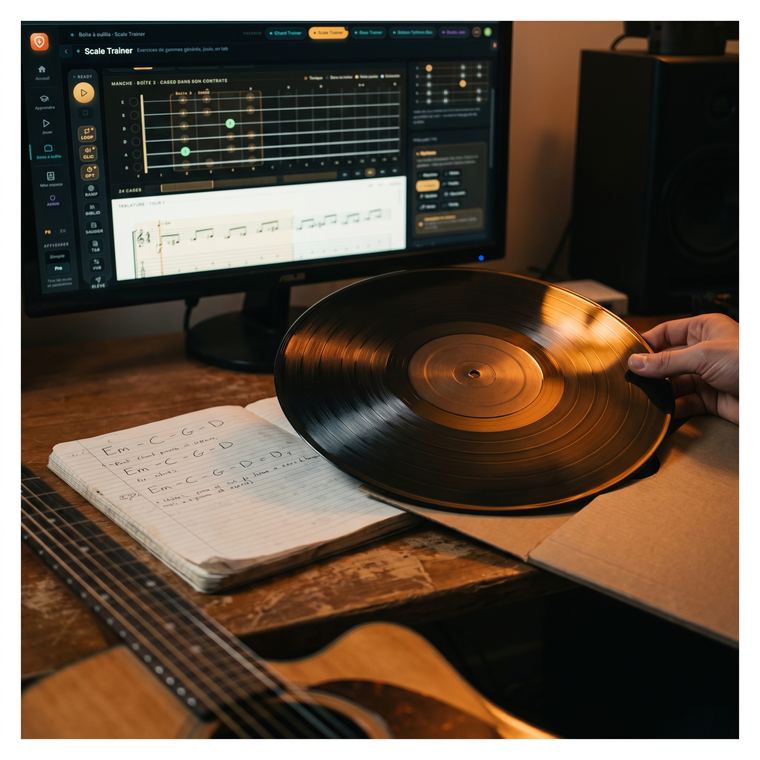
Where everything else comes together: listening to a song and understanding how it's built, playing the major styles, building a repertoire — and finally finding your own sound.
Getting started
- Listening to a style and spotting what defines it
- Your first song, chosen by you
- Rock and acoustic folk: two opposite approaches
- Recording yourself and listening back — the most underused tool there is
Progressing
- Blues: 12 bars, shuffle, your first two-note solo
- Folk and pop: the I-V-vi-IV progression and the capo
- Rock: power chords, iconic riffs, palm muting
- Building a repertoire of 3 to 5 songs played all the way through
Mastery
- Advanced blues: licks, bends, call & response
- Fingerstyle and arrangements of your own
- Funk, classic rock, jazz fundamentals
- Writing, recording, finding your musical identity
In the lesson itself: you're the one who brings the songs. We start from what you love listening to — motivation is a teaching tool, not a detail.
The complete programme, step by step, is also on the app page. See the Guitar Master page →
The same chord chart.
Six different bands.
Four chords, written once. This isn't one loop being transposed: for each style, the bass and the accompaniment are rewritten. Turn the sound on.
Pick a style to listen.
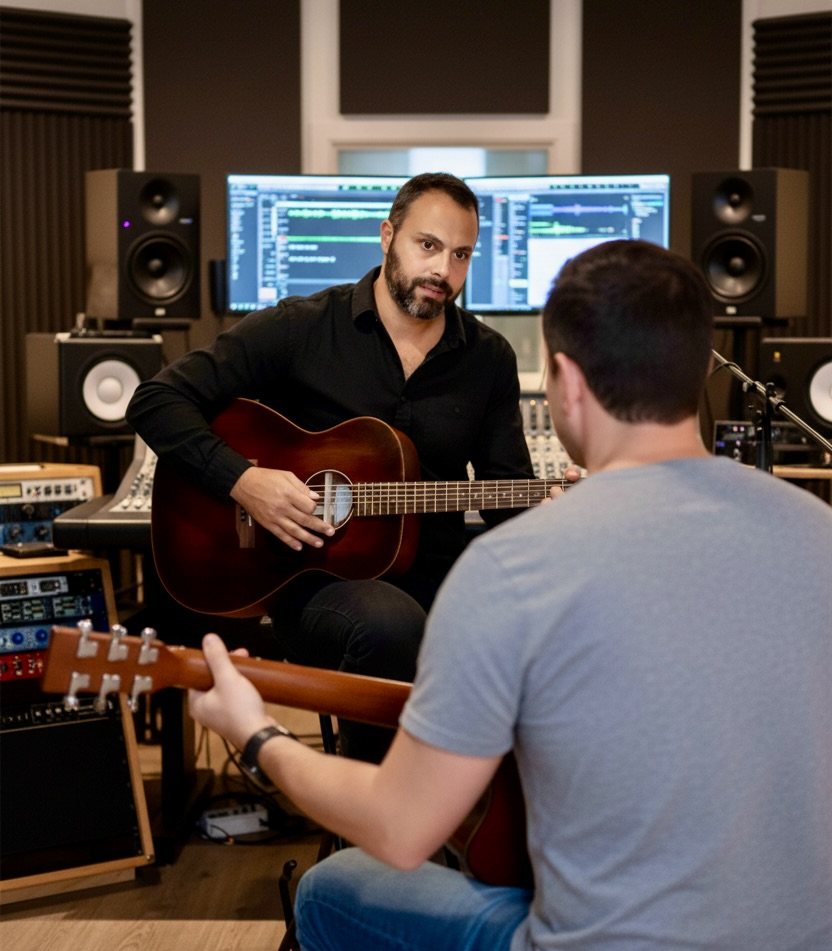
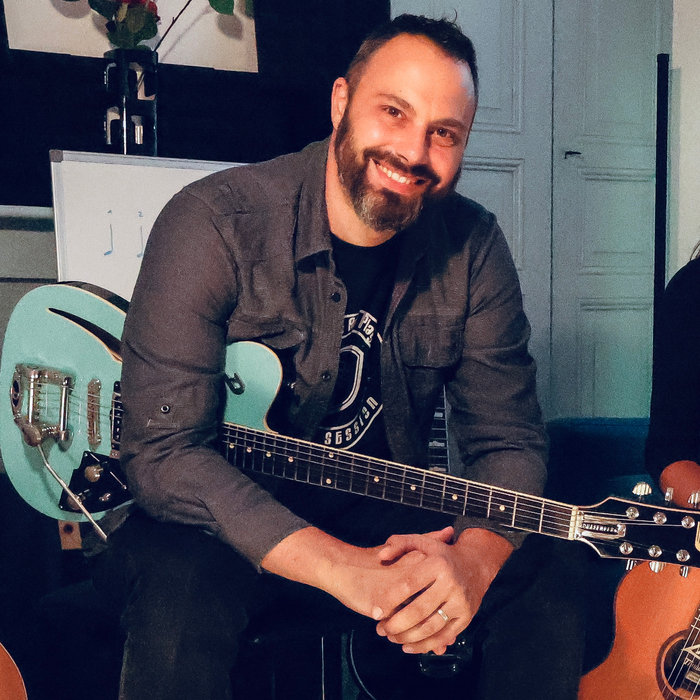
“For years I looked for the tool I wanted to leave my students with between lessons — the one that gets them playing, not just watching. It didn't exist. So we built it.”
- TuesdayYour lesson. We work together, inside the app. Before the session is over, I drop your exercises into your space.
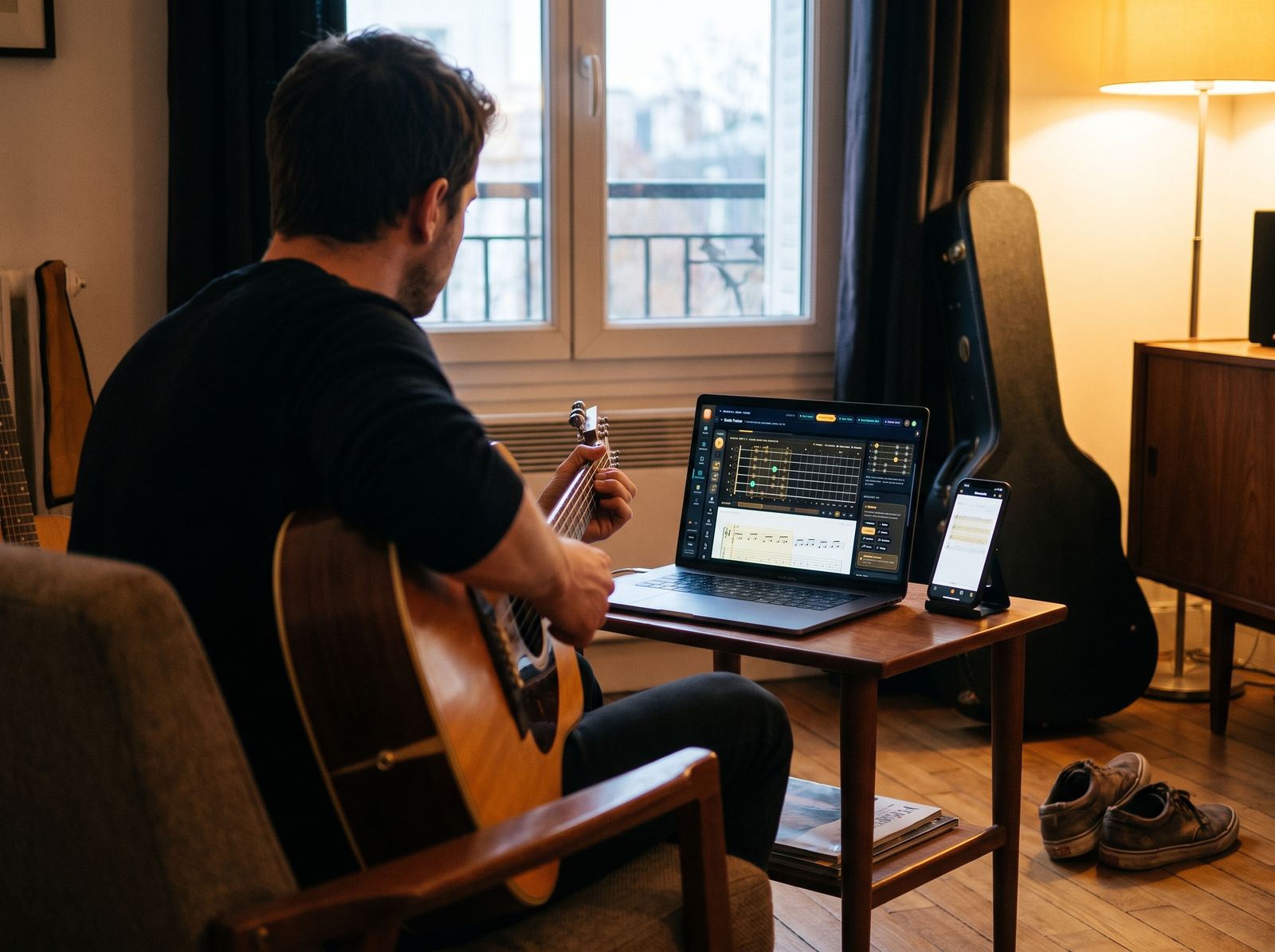
- ThursdayTwenty minutes at home. You open the app: the exercise is there, at the right tempo, with the band playing behind you.
- SundayThe song. You write out its chord chart, you play over it, you record yourself. And you tell me where it's going wrong.
Does this sound like you?
Three situations come up at almost every first lesson — the odds are good that one of them is yours.
You've played for years, and you've hit a ceiling
You can get through songs, but you don't understand what you're playing, and you always end up in the same two positions. We put things back in order: the fretboard, the harmony, the rhythm. It's the most common profile — and often the fastest to progress, because the fingers already follow.
You're picking it back up after years away
The guitar has slept in its case for ten or twenty years and you'd rather not embarrass yourself. We start from what your hands still know — always more than you think — without sending you back to square one.
You've never played a note
And you wonder whether it's too late. It isn't. What changes over time is how you learn: less by imitation, more by understanding. The whole progression is built on that.
What you won't find here
No compulsory sight-reading, no method that has you playing nursery rhymes for six months, no generic video to watch alone. You have little time and you want to understand what you're playing: that's exactly my job.
From your first chord to jazz voicings.
The same teaching suits the complete beginner and the guitarist looking to break out of old habits. We move at your pace, on your songs — and nothing is locked away in the app: the advanced settings are simply waiting until you need them.
You're a beginner
Tuning your guitar, holding a rhythm, moving between Em and Am without looking. We go in that order, skipping nothing — and you play a real song within the first few weeks, not in six months.
You're making progress
Barre chords, the five pentatonic positions, the ii-V-I, the shuffle. We work on the songs you bring, and we repair whatever is getting in the way. Nine times out of ten, it's the picking hand.
You're after more
Voicings with tensions, walking bass, comping, arrangement, improvisation, working things out by ear. At this level the lesson is mostly about asking precise questions and leaving with a month of concrete work.
The lesson doesn't stop
when the lesson stops.
Most online lessons end the moment the video call cuts out. Here, you leave with your exercises already waiting in Guitar Master — the app we develop at Solfia Édition for my students, and have been growing with them ever since.
Your exercises, already there
Before the session ends, I drop what we've just worked on into your space: the chord chart, the strumming pattern, the scale exercise. Nothing for you to write down.
A band to practise with
Your exercises aren't worked on in silence: the bass, the drums and the piano play behind you, in the style and at the tempo you want, for as long as you want.
I can see where it's sticking
What you practise comes back to my teacher's space. Next lesson, we don't lose ten minutes taking stock: I already know where we are.
Everywhere, even offline
On a computer in the browser, with nothing to install. On a phone by adding the app to your home screen. The tuner, the chords, the fretboard and the rhythm box work without a connection.
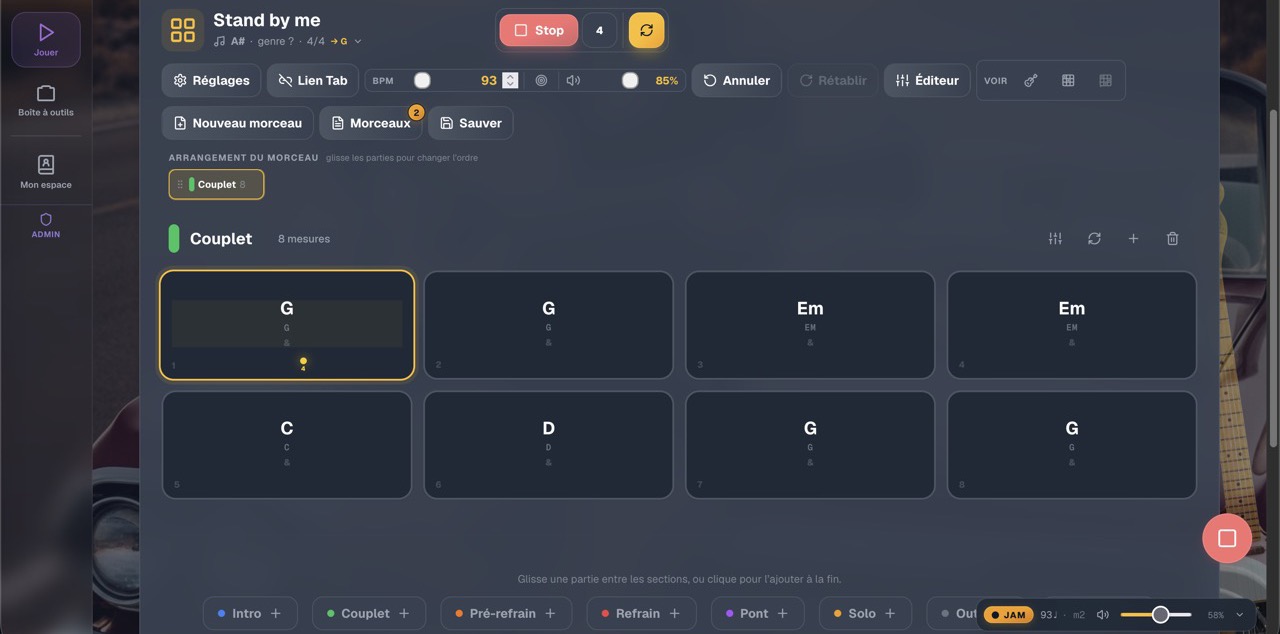
Twenty-four tools,
four trainers,
198 steps
- Studio Jam — you write the chart, the band plays behind you
- The four trainers — scales, chords, bass and piano written over your song
- Guitare Rythme Box — the picking hand, stroke by stroke, with a pick or fingers
- Studio Lab — plug your guitar in, eleven amps are waiting
- Studio Tab — a tab reader and editor compatible with Guitar Pro
A teacher, in front of you.
No app replaces someone watching you play and correcting what you can't hear yet. The lesson takes place inside the app itself: you join it in one click from your own space, and we work in the same tools. Over video, anywhere in France.

Self-taught at first, I trained at the contemporary music school ATLA (Paris), then on the Jazz and Contemporary Music course at the Amiens conservatoire. I used to teach in Amiens and Longueau; these days I give my lessons all over France, by video call.
It was while looking for the right tool to give my students, and never finding it, that I founded Solfia Édition to build it. The lessons and the app move forward together: I drop your exercises into it before the session is over.
The lesson happens in the app
No Zoom, no link to hunt for, no account to create somewhere else. You join the lesson in one click from your own space — and we work in the same tools.
You book
An email or a text, and we agree on a slot. Nothing to install: you need a guitar and a device with a camera, that's all.
You join in one click
At lesson time, a “Join” button appears in your space. You click, and there we are. The video goes straight between our two devices.
We look at the same screen
When I open the drum machine, the fretboard or a tab, it opens on your side too. Each of us at home, but on the same tool.
Your exercises stay put
By the end of the lesson they're already in your app: rhythms, chords, scales, tabs. Nothing to write down, nothing to copy out — you can work on them all week.
What my students say.
“He's an outstanding teacher, passionate and attentive. I've been taking lessons with Jean-Christophe for a year, and I can only recommend him 100%!”
“He's persistent, and always has a word of encouragement when it's needed. It's been a real pleasure for almost 3 years. I recommend him +++”
“He's a teacher who's always looking for the best way to get his teaching across, and who knows how to share his passion. I've been taking lessons with JC for 2 years and it's a real pleasure.”
Reviews published on Google by students of Jean-Christophe Vignon.
Pay as you go.
No subscription.
You book the length that suits you, whenever you want, with no commitment. The app is included in any month you take a lesson — nothing extra to pay.
The three lesson lengths
All by video call, all one-to-one. The hour is the one that leaves time to get to know each other, assess your level and set your goals — it's what I'd suggest for a first proper lesson.
30 minutes
For one specific thing: a song, a chord, a question you're stuck on.
30 min by video call · No subscription
- 1 one-to-one 30 min lesson by video call
- Exercises added to the app
- App included for the month of the lesson
- Ideal for getting unstuck on one specific point
45 minutes
The best balance of time and progress for a full lesson.
45 min by video call · No subscription
- One 45-minute private lesson by video call
- Web + mobile app included for the month of your lesson
- A personalised plan and personalised exercises
- The ideal format for real, regular follow-up
1 hour
The right format for a first lesson, and for digging into several topics.
1 hr by video call · No subscription
- One 1-hour private lesson by video call
- Web + mobile app included for the month of your lesson
- A personalised plan and personalised exercises
- Time to get to know each other and set your goals
The app and the lessons: your questions answered.
I'm already one of your students. What changes for me?
Nothing but the address. Your account, your exercises, your lessons and your progress are exactly the same. Just come through this page to log in, and bookmark it.
How much do lessons cost?
Pay as you go, with no subscription and no commitment: €20 for 30 minutes, €30 for 45 minutes, €40 an hour. You book the length that suits you, whenever you need it. For a first lesson, the hour is the format that leaves time to get to know each other, hear you play and set your goals. Access to the app is included in any month you take a lesson.
How does an online guitar lesson by video call work?
Everything happens inside the app — no link to hunt for, no software to install. We agree a time by email or text; at the appointed hour, a “Join” button appears in your account. One click and the lesson starts, one to one — the video goes straight between our two devices. During the session, whatever tool I open on my side opens on yours too: chord diagrams, drum machine, scales on the fretboard, tabs. We look at the same screen, each from home. By the end of the lesson, your exercises are already waiting in your app.
Is a lesson by video call as good as one in person?
For most of the work, yes. Posture, hand positions, timing and tone all come across perfectly with a simple webcam or a well-placed phone. The real advantage of the online lesson is what happens afterwards: thanks to the app, the lesson doesn't stop when we hang up.
I'm 40 and have never touched a guitar. Too late?
No — and that describes a good many of my students. The adult brain learns very well; it simply learns differently from a child's, and my teaching is built around that: a realistic pace, concrete goals, no music theory forced on you, and above all enjoyment from the very first sessions.
Do I need to be able to read music?
No, no music reading is required. We work with tabs, chord diagrams, the fretboard and your ear. Theory does come into it, but always applied straight to the guitar — never in the abstract.
What if I live near Amiens?
You can of course take in-person guitar lessons in Amiens and Longueau — that's where it all started for me, and the app is included there too. Lessons by video call are for everyone who lives too far away, or who prefers the flexibility of learning remotely.
What is this fifteen-minute call?
A call with no guitar and no commitment, just to get acquainted. We look at where you are, what you'd like to play, and how much time you can realistically give it in a week. I'll tell you plainly whether I'm the right teacher for you, and what to start with. If it turns out you don't need lessons, I'll say that too.
What equipment do I need?
A guitar, a device with a camera and a microphone — a laptop or a phone on a stand will do — and a decent internet connection. Nothing else. Headphones make it more comfortable, and a phone stand that shows both hands makes the lesson far more useful, but we can start without.
How often should I take lessons?
There's no rule, and certainly no subscription. Some students come every week, others once a month to take stock and leave with a month's work. That's exactly what the app is for: between sessions, you're not left alone with your notes.
Online guitar lessons for adults, by video call, with a qualified teacher.
Prof-de-guitare.com offers one-to-one guitar lessons by video call, anywhere in France, taught by Jean-Christophe Vignon — a guitar teacher trained at the ATLA school of contemporary music in Paris and at the Jazz and Contemporary Music course of the Amiens conservatoire, with sixteen years of teaching and more than three hundred students behind him. Every lesson carries on inside Guitar Master, the app developed by Solfia Édition, his development studio, and designed with him for his own students.
Teaching built over sixteen years of lessons
My students have little time, not much patience, and often a bad experience behind them. The whole progression is built on that: concrete goals, songs you chose yourself, no compulsory sight-reading, and an explanation of what you're playing whenever it actually helps. Less learning by imitation, more by understanding — slower at first, far more solid afterwards.
The three profiles I meet most often
The self-taught player who has hit a ceiling has played for years, can get through songs, but doesn't understand what they're playing and always falls back on the same positions. We put things back in order: the fretboard, the harmony, the rhythm. The returner thinks they've forgotten everything; their hands almost always know more than they think, and we start from there rather than from scratch. The complete beginner wants to play a real song without spending six months on exercises: that's perfectly possible, provided things are done in the right order.
How a guitar lesson by video call works
The lesson takes place inside the app itself: no software to install, no link to hunt for, no account to create with a third-party service. At lesson time a "Join" button appears in your space; one click, and the video goes straight between our two devices. During the session, whatever tool I open on my side opens on your screen too: chord diagrams, rhythm box, scales on the fretboard, tabs. For most of the work — posture, hand positions, timing, tone — a video call shows everything that needs to be seen, with a simple webcam or a phone on a stand.
What happens between lessons
This is where it differs from a conventional lesson. Before the session ends, I put your exercises in your space: the song's chord chart, the strumming pattern we worked on, the scale exercise, the tab. Nothing for you to write down. During the week you find them in the app, at the right tempo, with the bass, the drums and the piano playing behind you. And what you practise comes back to me, which saves spending the start of the next lesson taking stock.
Prices and booking
Lessons are pay as you go, with no subscription and no commitment: €20 for 30 minutes, €30 for 45 minutes, €40 for an hour. Access to the web and mobile app is included in any month you take a lesson. Before booking, a free fifteen-minute call lets us take stock with no guitar and no commitment. Booking is by email or text, with a reply within 24 hours.
What if I only want the app?
That's possible, and it has its own page: Guitar Master can be used without lessons, with a core set of tools free for everyone and a subscription for the rest. Independent guitar teachers who'd like to use it with their own students will find their plan there too.
Online lessons or in-person lessons?
If you live in Amiens, Longueau or nearby, in-person guitar lessons are still possible and also give access to the app. Anywhere else in France, the video format offers the same teaching, the same follow-up and far more freedom over timing.
Pick up your
guitar.
A free fifteen-minute call to work out where to start. Then lessons pay as you go, no subscription, from €20 — and an app that stays with you all week.